
The Bible Directory · Questions Worth Exploring
Deuteronomistic History: From Deuteronomy to Kings
Shared language. Recurring judgments. A history that ends in exile. Explore why scholars read Deuteronomy and the books of Joshua through Kings together.
Explore the member research edition ↓

What is Deuteronomistic History?
The term names a scholarly proposal about how Deuteronomy, Joshua, Judges, Samuel and Kings were shaped into a connected account. Their recurring language and concerns have led researchers to investigate shared authorship, editing and the reuse of older material. It is a model of literary development, not an ancient title or the name of a known author.
In the usual definition, the group includes Deuteronomy · Joshua · Judges · 1–2 Samuel · 1–2 Kings. Ruth and Chronicles are not included, even though some Bible arrangements place Ruth among these books.
Two similar terms
Deuteronomic usually describes Deuteronomy itself or material closely associated with it. Deuteronomistic commonly describes related language, theological perspectives or proposed editing in a wider group of writings. Scholars do not always draw the boundary in the same place.
Read the connections for yourself
Wholehearted loyalty: compare Deuteronomy 6:5 with the description of Josiah in 2 Kings 23:25. Notice the language of heart, soul and strength, and the explicit reference to the law of Moses. Deuteronomy 6 → · 2 Kings 23 →
The place of worship: Deuteronomy 12:5–14 directs worship toward the place chosen by God. Compare the removal of local worship sites in 2 Kings 23:8–9. The comparison concerns the texts’ stated priorities; it does not establish one author by itself. Deuteronomy 12 → · 2 Kings 23 →
Explaining a kingdom’s fall: 2 Kings 17:7–23 looks back on Israel’s practices to explain its defeat and deportation. Compare the warnings of displacement in Deuteronomy 28:36–37, 63–68. These passages let readers examine how the narrative connects political disaster with covenant obligations. 2 Kings 17 → · Deuteronomy 28 →
Who put these books together?
Martin Noth’s influential 1943 proposal described an exilic author who shaped inherited traditions into a larger work. Later scholars proposed earlier editions, several rounds of editing or different relationships among the individual books. Some question whether there was ever one unified Deuteronomistic History. Shared wording is an observation; a complete reconstruction of the editorial process is an argument.
An inscription offers another perspective
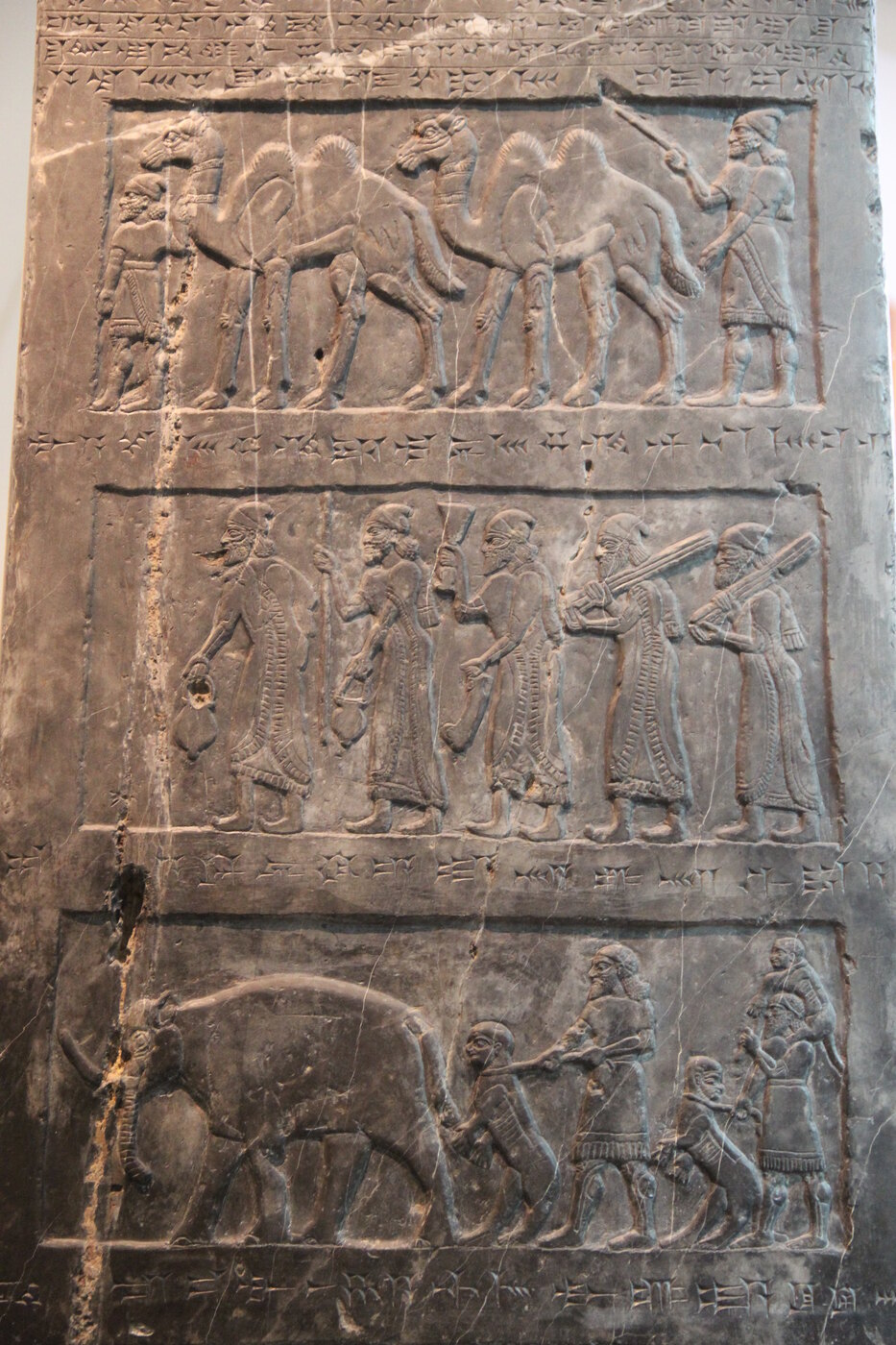
The Black Obelisk pictured above is an Assyrian royal monument associated with tribute from Jehu of Israel. Kings also describes Jehu, but selects and evaluates his actions for its own narrative purposes. An inscription and a biblical account can illuminate the same political world while emphasizing different things. The monument does not identify the editors of Kings. Read 2 Kings 10 →
Research Paths
Christine Hayes · The Deuteronomistic History: Life in the Land ↗
Open Yale Courses · English lecture and transcript introducing the proposal and the books involved.
Simone Paganini · Deuteronomistisches Geschichtswerk ↗
WiBiLex · German scholarly reference explaining Noth, later models and the continuing debate.
Christine Hayes · Response to Catastrophe: 1 and 2 Kings ↗
Open Yale Courses · English discussion of kingship, covenant and the literary response to defeat.
British Museum · The Black Obelisk ↗
Museum account hosted by Google Arts & Culture · the monument, tribute scenes and Assyrian setting.