
James 1
1 James, a servant of God and of the Lord Jesus Christ, to the twelve tribes which are scattered abroad, greeting.
2 My brethren, count it all joy when ye fall into divers temptations;
3 Knowing this, that the trying of your faith worketh patience.
4 But let patience have her perfect work, that ye may be perfect and entire, wanting nothing.
5 If any of you lack wisdom, let him ask of God, that giveth to all men liberally, and upbraideth not; and it shall be given him.
6 But let him ask in faith, nothing wavering. For he that wavereth is like a wave of the sea driven with the wind and tossed.
7 For let not that man think that he shall receive any thing of the Lord.
8 A double minded man is unstable in all his ways.
9 Let the brother of low degree rejoice in that he is exalted:
10 But the rich, in that he is made low: because as the flower of the grass he shall pass away.
11 For the sun is no sooner risen with a burning heat, but it withereth the grass, and the flower thereof falleth, and the grace of the fashion of it perisheth: so also shall the rich man fade away in his ways.
12 Blessed is the man that endureth temptation: for when he is tried, he shall receive the crown of life, which the Lord hath promised to them that love him.
13 Let no man say when he is tempted, I am tempted of God: for God cannot be tempted with evil, neither tempteth he any man:
14 But every man is tempted, when he is drawn away of his own lust, and enticed.
15 Then when lust hath conceived, it bringeth forth sin: and sin, when it is finished, bringeth forth death.
16 Do not err, my beloved brethren.
17 Every good gift and every perfect gift is from above, and cometh down from the Father of lights, with whom is no variableness, neither shadow of turning.
18 Of his own will begat he us with the word of truth, that we should be a kind of firstfruits of his creatures.
19 Wherefore, my beloved brethren, let every man be swift to hear, slow to speak, slow to wrath:
20 For the wrath of man worketh not the righteousness of God.
21 Wherefore lay apart all filthiness and superfluity of naughtiness, and receive with meekness the engrafted word, which is able to save your souls.
22 But be ye doers of the word, and not hearers only, deceiving your own selves.
23 For if any be a hearer of the word, and not a doer, he is like unto a man beholding his natural face in a glass:
24 For he beholdeth himself, and goeth his way, and straightway forgetteth what manner of man he was.
25 But whoso looketh into the perfect law of liberty, and continueth therein, he being not a forgetful hearer, but a doer of the work, this man shall be blessed in his deed.
26 If any man among you seem to be religious, and bridleth not his tongue, but deceiveth his own heart, this man's religion is vain.
27 Pure religion and undefiled before God and the Father is this, To visit the fatherless and widows in their affliction, and to keep himself unspotted from the world.
World Behind This Chapter
Explore the people, places, language, history, and material world connected to James 1.
Which James does the opening actually identify?
James 1:1 gives a name and a servant designation, followed by the twelve tribes in the dispersion. It does not name a parent, sibling or city. Compare the traditional identification with James, the brother of Jesus, with other proposals, keeping the greeting’s actual claims distinct from later attribution.
How do trials and temptation share vocabulary?
Compare the testing language of 1:2–4 and 1:12 with desire and temptation in 1:13–15. Related Greek words can describe testing or enticement, depending on context. Follow the change in agents and actions before making every occurrence of the KJV’s temptation mean exactly the same thing.
What does being complete have to do with asking for wisdom?
In 1:4–8 completeness and lacking are followed by asking for wisdom and a picture of instability. Compare perfect, complete and mature in translations. The linked vocabulary helps trace the instruction; it does not give a measurable educational qualification or describe a person who has never made a mistake.
WORTH A CLOSER LOOK
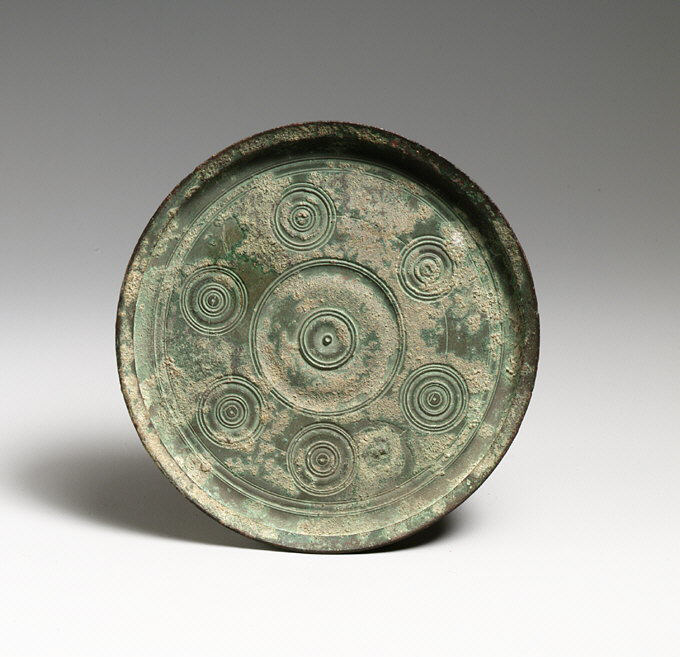
A bronze mirror and the act of looking
James 1:23–24 compares hearing without doing to looking in a mirror and forgetting. This Greek or Roman bronze mirror, dated approximately 100 BCE–100 CE, offers a period comparison. The photograph shows its decorated back, with seven concentric-circle ornaments, rather than a bright reflecting face. The text does not identify its mirror’s material, and this object has no known connection with the author or audience. Met 74.51.5405.
Explore the historical sourceResearch PathsCurated links for exploring this chapter 3
Language & Literature3
- Compare the fading-flower image in IsaiahCrossway · Isaiah 40 primary text
Read Isaiah 40:6–8 with James 1:9–11. Identify shared imagery and differences in the surrounding argument rather than treating every image as a report of the same event.
- Investigate authorship and the letter’s social concernsYale Bible Study · The Epistle of James
Read the opening discussion of attribution alongside James 1:1. The guide favors a later author; compare its reasoning with traditional attribution and distinguish proposed dating from an explicit date in the letter.
- James 1: translation and textual notesNET Bible
Compare the KJV with the translation and notes. Identify the wording at issue before weighing proposed historical or theological explanations.
Explore the full chapter collection
Directory Members can explore all the available questions, closer-look items, and curated links for this chapter.
Public Discussion
Your display name and comment can be seen by anyone visiting this chapter. Do not include private or sensitive information. Read the Community Guidelines.
You must be logged in to post a comment.