
Philippians 3
1 Finally, my brethren, rejoice in the Lord. To write the same things to you, to me indeed is not grievous, but for you it is safe.
2 Beware of dogs, beware of evil workers, beware of the concision.
3 For we are the circumcision, which worship God in the spirit, and rejoice in Christ Jesus, and have no confidence in the flesh.
4 Though I might also have confidence in the flesh. If any other man thinketh that he hath whereof he might trust in the flesh, I more:
5 Circumcised the eighth day, of the stock of Israel, of the tribe of Benjamin, an Hebrew of the Hebrews; as touching the law, a Pharisee;
6 Concerning zeal, persecuting the church; touching the righteousness which is in the law, blameless.
7 But what things were gain to me, those I counted loss for Christ.
8 Yea doubtless, and I count all things but loss for the excellency of the knowledge of Christ Jesus my Lord: for whom I have suffered the loss of all things, and do count them but dung, that I may win Christ,
9 And be found in him, not having mine own righteousness, which is of the law, but that which is through the faith of Christ, the righteousness which is of God by faith:
10 That I may know him, and the power of his resurrection, and the fellowship of his sufferings, being made conformable unto his death;
11 If by any means I might attain unto the resurrection of the dead.
12 Not as though I had already attained, either were already perfect: but I follow after, if that I may apprehend that for which also I am apprehended of Christ Jesus.
13 Brethren, I count not myself to have apprehended: but this one thing I do, forgetting those things which are behind, and reaching forth unto those things which are before,
14 I press toward the mark for the prize of the high calling of God in Christ Jesus.
15 Let us therefore, as many as be perfect, be thus minded: and if in any thing ye be otherwise minded, God shall reveal even this unto you.
16 Nevertheless, whereto we have already attained, let us walk by the same rule, let us mind the same thing.
17 Brethren, be followers together of me, and mark them which walk so as ye have us for an ensample.
18 For many walk, of whom I have told you often, and now tell you even weeping, that they are the enemies of the cross of Christ:
19 Whose end is destruction, whose God is their belly, and whose glory is in their shame, who mind earthly things.
20 For our conversation is in heaven; from whence also we look for the Saviour, the Lord Jesus Christ:
21 Who shall change our vile body, that it may be fashioned like unto his glorious body, according to the working whereby he is able even to subdue all things unto himself.
World Behind This Chapter
Explore the people, places, language, history, and material world connected to Philippians 3.
Does the sharp opening establish that another letter has been inserted?
Philippians 3:1–2 moves from rejoicing and repeated instruction into a severe warning. Changes of tone and other transitions have prompted theories combining several letters, while other scholars defend a unified composition. The transition alone does not identify the boundaries, dates or original copies of hypothetical letters.
Who is targeted by the circumcision wordplay?
In 3:2–3 harsh labels and bodily wordplay distinguish people the writer warns against from the community he describes. Their exact identity is reconstructed rather than named here. The polemic should not be generalized into a claim about the character or worth of all Jewish people or circumcised men.
How are ancestry, practice and zeal arranged in the self-description?
Philippians 3:4–6 lists circumcision, Israelite and Benjaminite ancestry, Hebrew identity, Pharisaic affiliation, zeal and conduct. Consider the categories individually before treating them as one credential. This is a selective self-presentation within an argument, not a census document or a description of every Pharisee.
WORTH A CLOSER LOOK
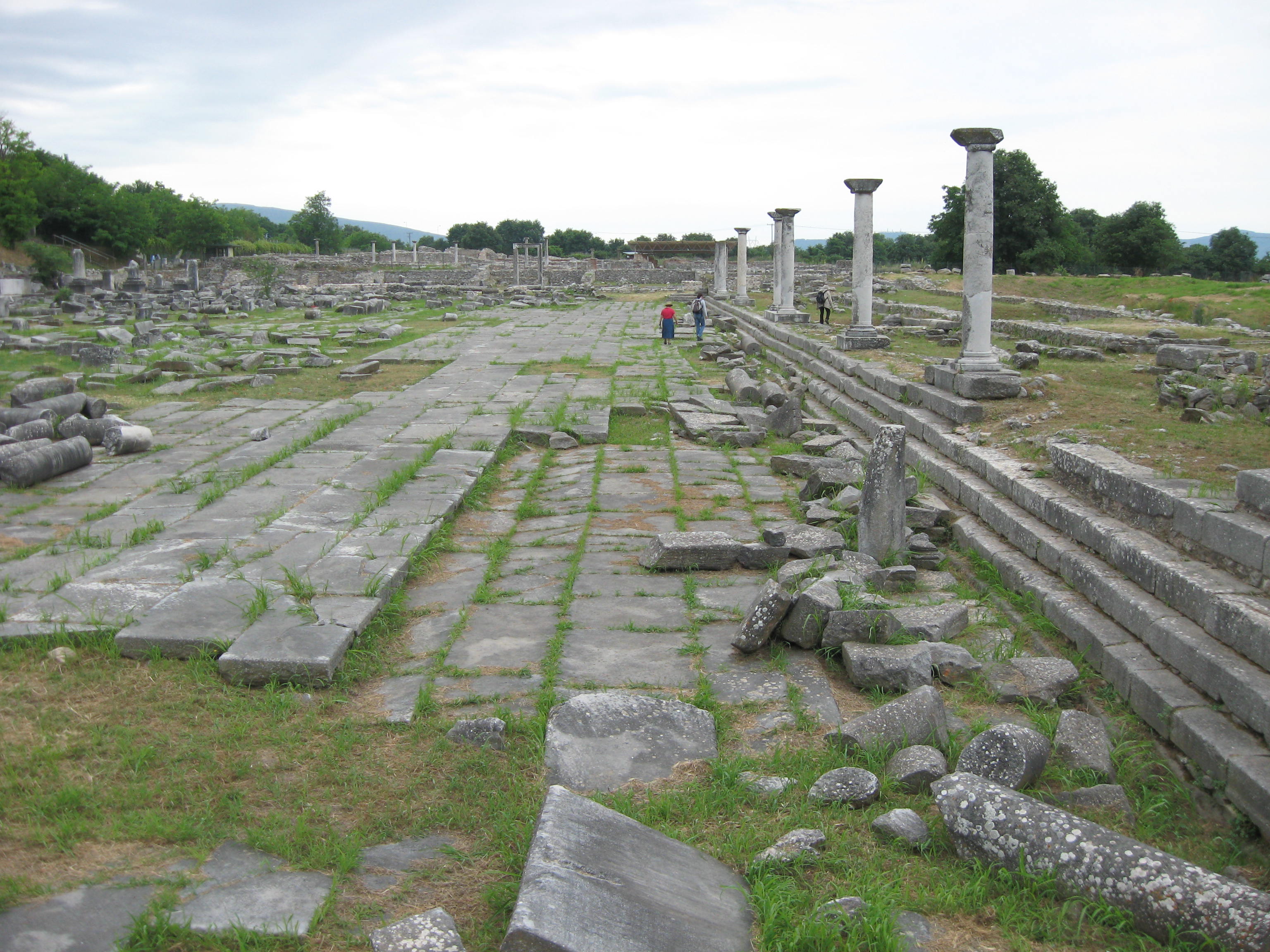
Philippi’s civic landscape: the agora
This real photograph shows the agora or forum area at Philippi, the Roman colony addressed by the letter. Read the civic language in 3:20 beside the city’s public setting, while keeping the metaphor distinct from legal citizenship. The visible remains belong to several phases and include later Roman building work; the photograph is not a reconstruction of the city in one year or an identified location where this letter was read.
Explore the historical sourceResearch PathsCurated links for exploring this chapter 3
History & Daily Life1
- Investigate ancient athletic contests and prizesThe Metropolitan Museum of Art · Colette and Séan Hemingway
The museum essay supplies context for athletic competition and prizes. Many illustrated objects are centuries earlier than Philippians; they are comparisons, not artifacts from a race named in this letter.
Language & Literature2
- Investigate the Greek word πολίτευμαUniversity of Chicago · Logeion
Compare citizenship, commonwealth or civic-community possibilities with the expectation expressed in 3:20–21. Read the cited uses beside the sentence; a word does not carry all its dictionary senses at once.
- Philippians 3: compare translation and textual notesNET Bible
Compare the KJV with the translation and manuscript notes. Distinguish textual readings, translation decisions and historical proposals; commentary presents arguments rather than additional statements by the letter.
Explore the full chapter collection
Directory Members can explore all the available questions, closer-look items, and curated links for this chapter.
Public Discussion
Your display name and comment can be seen by anyone visiting this chapter. Do not include private or sensitive information. Read the Community Guidelines.
You must be logged in to post a comment.