
Titus 1
1 Paul, a servant of God, and an apostle of Jesus Christ, according to the faith of God's elect, and the acknowledging of the truth which is after godliness;
2 In hope of eternal life, which God, that cannot lie, promised before the world began;
3 But hath in due times manifested his word through preaching, which is committed unto me according to the commandment of God our Saviour;
4 To Titus, mine own son after the common faith: Grace, mercy, and peace, from God the Father and the Lord Jesus Christ our Saviour.
5 For this cause left I thee in Crete, that thou shouldest set in order the things that are wanting, and ordain elders in every city, as I had appointed thee:
6 If any be blameless, the husband of one wife, having faithful children not accused of riot or unruly.
7 For a bishop must be blameless, as the steward of God; not selfwilled, not soon angry, not given to wine, no striker, not given to filthy lucre;
8 But a lover of hospitality, a lover of good men, sober, just, holy, temperate;
9 Holding fast the faithful word as he hath been taught, that he may be able by sound doctrine both to exhort and to convince the gainsayers.
10 For there are many unruly and vain talkers and deceivers, specially they of the circumcision:
11 Whose mouths must be stopped, who subvert whole houses, teaching things which they ought not, for filthy lucre's sake.
12 One of themselves, even a prophet of their own, said, The Cretians are alway liars, evil beasts, slow bellies.
13 This witness is true. Wherefore rebuke them sharply, that they may be sound in the faith;
14 Not giving heed to Jewish fables, and commandments of men, that turn from the truth.
15 Unto the pure all things are pure: but unto them that are defiled and unbelieving is nothing pure; but even their mind and conscience is defiled.
16 They profess that they know God; but in works they deny him, being abominable, and disobedient, and unto every good work reprobate.
World Behind This Chapter
Explore the people, places, language, history, and material world connected to Titus 1.
What does the expanded greeting emphasize?
In 1:1–4 the speaking Paul connects service, proclamation, truth, piety and hope before addressing Titus. Compare the opening with Galatians and 2 Corinthians, where Titus also appears. The shared name and relationship inform historical investigation without independently settling who composed this letter.
What can be mapped from the assignment in Crete?
In 1:5 Titus is represented as left in Crete to complete unfinished work and appoint elders town by town. The island is named, but no Cretan town is specified. Compare Acts 27 carefully: its account of a voyage through Crete does not itself narrate this assignment.
How are elders, overseer and household language connected?
In 1:5–9 instructions concerning elders lead into the singular overseer described as God’s steward. Compare the sequence with 1 Timothy 3. The wording invites study of leadership and household expectations without supplying a complete later hierarchy or resolving every question about marriage and children.
WORTH A CLOSER LOOK
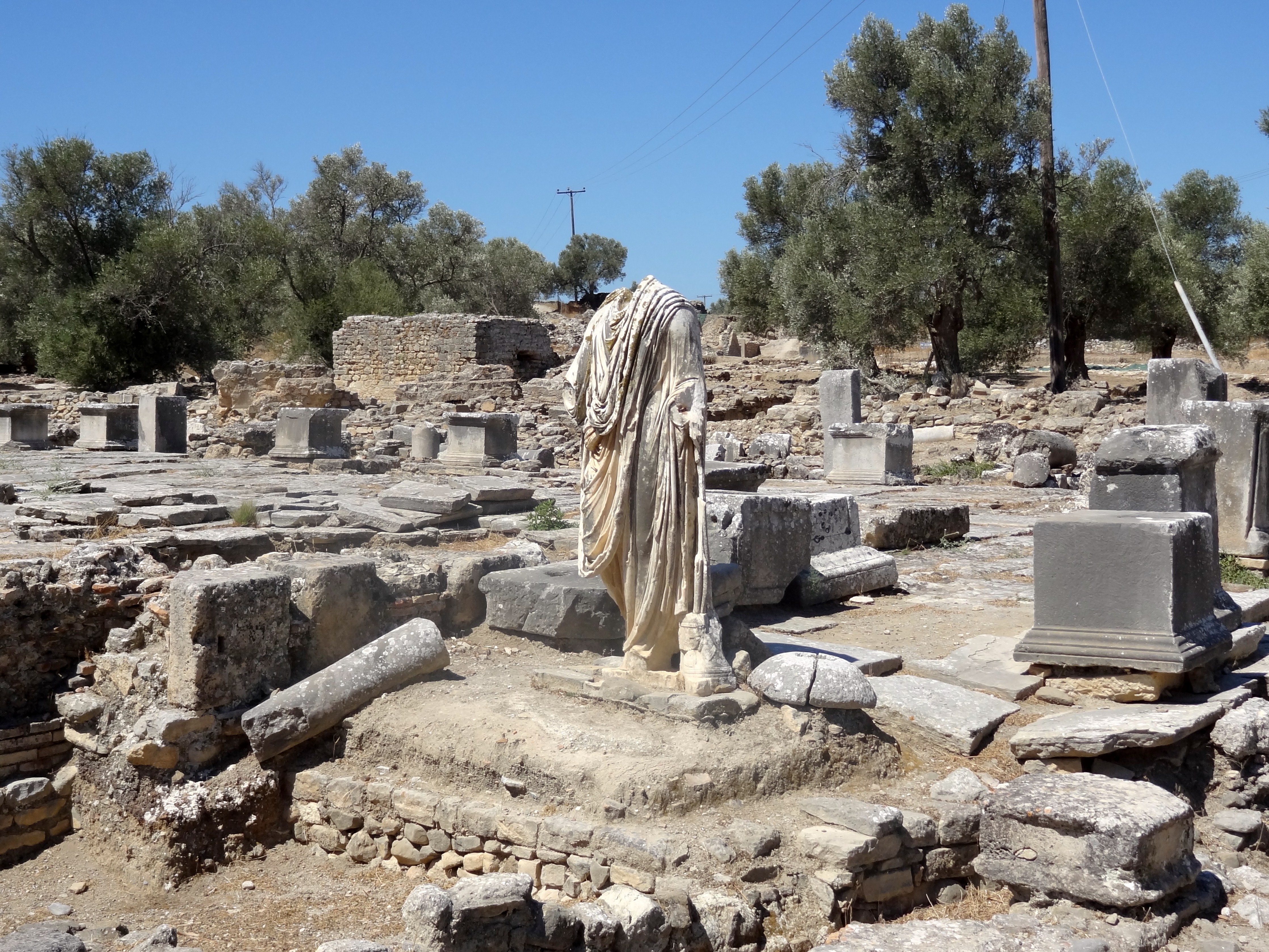
Crete beyond the letter: ruins at Gortyn
Olaf Tausch photographed these remains at Gortyn on 2 September 2012. The site opens a view onto Crete’s Greek and Roman urban world, with structures belonging to different building phases rather than one frozen moment. Compare that wider island setting with the town-by-town assignment in Titus 1:5. Gortyn is not named in the letter, and this photograph identifies neither Titus’s residence nor a meeting place. A modern photograph’s date must remain distinct from the date of an ancient structure and from the disputed composition date of the letter.
Explore the historical sourceResearch PathsCurated links for exploring this chapter 3
Language & Literature3
- Investigate the Pastorals’ authorship and literary settingYale Bible Study · The Pastoral Epistles
The guide favors later authorship and examines the letters’ structures and social concerns. Compare its arguments with Pauline reconstructions and consider Titus individually rather than assuming that all three Pastorals must have identical histories.
- Read the earlier poetic parallel in contextToposText · Callimachus, Hymn to Zeus, translated by A. W. Mair
Read the Cretan phrase near the beginning of the hymn in its dispute over Zeus’s birthplace and tomb. It parallels part of the quotation, not all of Titus 1:12. The site’s tagged mythic event dates are not the composition date of Callimachus’s Hellenistic poem.
- Titus 1: translation and textual notesNET Bible
Compare the KJV with the translation and notes. Distinguish manuscript readings, translation choices and historical reconstructions.
Explore the full chapter collection
Directory Members can explore all the available questions, closer-look items, and curated links for this chapter.
Public Discussion
Your display name and comment can be seen by anyone visiting this chapter. Do not include private or sensitive information. Read the Community Guidelines.
You must be logged in to post a comment.