
Philemon 1
1 Paul, a prisoner of Jesus Christ, and Timothy our brother, unto Philemon our dearly beloved, and fellowlabourer,
2 And to our beloved Apphia, and Archippus our fellowsoldier, and to the church in thy house:
3 Grace to you, and peace, from God our Father and the Lord Jesus Christ.
4 I thank my God, making mention of thee always in my prayers,
5 Hearing of thy love and faith, which thou hast toward the Lord Jesus, and toward all saints;
6 That the communication of thy faith may become effectual by the acknowledging of every good thing which is in you in Christ Jesus.
7 For we have great joy and consolation in thy love, because the bowels of the saints are refreshed by thee, brother.
8 Wherefore, though I might be much bold in Christ to enjoin thee that which is convenient,
9 Yet for love's sake I rather beseech thee, being such an one as Paul the aged, and now also a prisoner of Jesus Christ.
10 I beseech thee for my son Onesimus, whom I have begotten in my bonds:
11 Which in time past was to thee unprofitable, but now profitable to thee and to me:
12 Whom I have sent again: thou therefore receive him, that is, mine own bowels:
13 Whom I would have retained with me, that in thy stead he might have ministered unto me in the bonds of the gospel:
14 But without thy mind would I do nothing; that thy benefit should not be as it were of necessity, but willingly.
15 For perhaps he therefore departed for a season, that thou shouldest receive him for ever;
16 Not now as a servant, but above a servant, a brother beloved, specially to me, but how much more unto thee, both in the flesh, and in the Lord?
17 If thou count me therefore a partner, receive him as myself.
18 If he hath wronged thee, or oweth thee ought, put that on mine account;
19 I Paul have written it with mine own hand, I will repay it: albeit I do not say to thee how thou owest unto me even thine own self besides.
20 Yea, brother, let me have joy of thee in the Lord: refresh my bowels in the Lord.
21 Having confidence in thy obedience I wrote unto thee, knowing that thou wilt also do more than I say.
22 But withal prepare me also a lodging: for I trust that through your prayers I shall be given unto you.
23 There salute thee Epaphras, my fellowprisoner in Christ Jesus;
24 Marcus, Aristarchus, Demas, Lucas, my fellowlabourers.
25 The grace of our Lord Jesus Christ be with your spirit. Amen.
World Behind This Chapter
Explore the people, places, language, history, and material world connected to Philemon 1.
Who is addressed, and how private is the appeal?
The opening names Philemon, Apphia, Archippus and an assembly in a house, alongside Paul and Timothy as senders. Compare singular and plural address through the letter. Apphia’s and Archippus’s family relationships are often reconstructed, but not stated; this is more than a letter with only one named reader.
Why is the place of imprisonment still debated?
Paul refers to imprisonment and requests accommodation in verse 22, but names no writing city. Rome, Ephesus and Caesarea feature in scholarly reconstructions. Compare Colossians and Acts without treating their connections as an explicit date or address in this letter; the visit remains a hope.
Does the letter say that Onesimus escaped or stole?
Verses 10–18 concern Onesimus’s separation, return and status, with a conditional reference to possible wrongdoing or debt. The familiar account of theft and flight goes beyond those statements. Scholars compare several scenarios, including seeking mediation. No independent account from Onesimus survives here.
WORTH A CLOSER LOOK
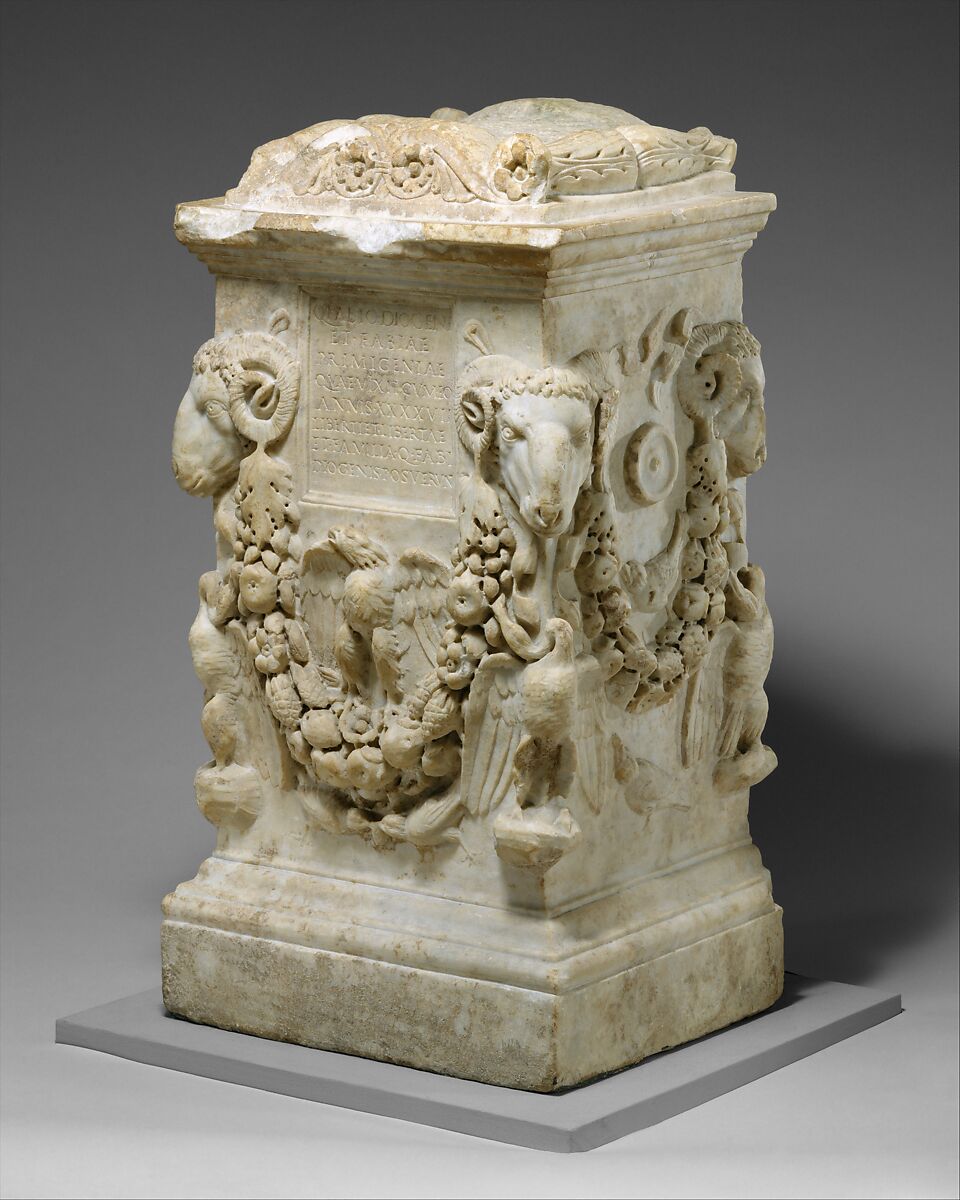
A Roman household remembered by freed and enslaved people
This marble funerary altar, dated by The Met to approximately 14–68 CE, commemorates Q. Fabius Diogenes and Fabia Primigenia. Its inscription says that freedmen, freedwomen and household slaves set it up. The museum considers Diogenes probably a freedman himself, a reconstruction distinct from the inscription’s named groups. Compare the coexistence of these statuses with Philemon’s language about slavery, partnership and brotherhood. The monument is not connected with Philemon or Onesimus, and commemoration does not erase the coercion of enslavement.
Explore the historical sourceResearch PathsCurated links for exploring this chapter 3
History & Daily Life1
- Explore the distinction between enslaved and freed peopleUniversity of Bonn · Bonn Center for Dependency and Slavery Studies
Follow Slaves and Freedpeople and the accompanying inscriptions. Roman Bonn provides documented regional examples of dependency and freedom, not a record of Onesimus’s life or a reason to treat all Roman households as identical.
Language & Literature2
- Compare an ancient request for reconciliationPomona College · Pliny, Letters 9.21 and 9.24, translated by William Melmoth
Find 9.21, addressed to Sabinianus, and the follow-up at 9.24. Pliny intercedes for a freedman, whose legal status differs from an enslaved person’s. This early-second-century comparison illuminates persuasion and mediation without proving direct literary dependence or identical circumstances.
- Investigate the historical setting and unanswered questionsYale Bible Study · The Epistle to Philemon
The guide discusses the letter’s unusual character and proposes a Roman setting. Compare the reconstruction with alternatives and keep the recipients’ precise household relationships and the eventual outcome open to investigation.
Explore the full chapter collection
Directory Members can explore all the available questions, closer-look items, and curated links for this chapter.
Public Discussion
Your display name and comment can be seen by anyone visiting this chapter. Do not include private or sensitive information. Read the Community Guidelines.
You must be logged in to post a comment.