
Hebrews 1
1 God, who at sundry times and in divers manners spake in time past unto the fathers by the prophets,
2 Hath in these last days spoken unto us by his Son, whom he hath appointed heir of all things, by whom also he made the worlds;
3 Who being the brightness of his glory, and the express image of his person, and upholding all things by the word of his power, when he had by himself purged our sins, sat down on the right hand of the Majesty on high;
4 Being made so much better than the angels, as he hath by inheritance obtained a more excellent name than they.
5 For unto which of the angels said he at any time, Thou art my Son, this day have I begotten thee? And again, I will be to him a Father, and he shall be to me a Son?
6 And again, when he bringeth in the firstbegotten into the world, he saith, And let all the angels of God worship him.
7 And of the angels he saith, Who maketh his angels spirits, and his ministers a flame of fire.
8 But unto the Son he saith, Thy throne, O God, is for ever and ever: a sceptre of righteousness is the sceptre of thy kingdom.
9 Thou hast loved righteousness, and hated iniquity; therefore God, even thy God, hath anointed thee with the oil of gladness above thy fellows.
10 And, Thou, Lord, in the beginning hast laid the foundation of the earth; and the heavens are the works of thine hands:
11 They shall perish; but thou remainest; and they all shall wax old as doth a garment;
12 And as a vesture shalt thou fold them up, and they shall be changed: but thou art the same, and thy years shall not fail.
13 But to which of the angels said he at any time, Sit on my right hand, until I make thine enemies thy footstool?
14 Are they not all ministering spirits, sent forth to minister for them who shall be heirs of salvation?
World Behind This Chapter
Explore the people, places, language, history, and material world connected to Hebrews 1.
Why does the traditional title not identify the author?
Hebrews begins with a statement about divine speech, not a named sender. Its association with Paul belongs to its reception history; most scholars do not regard it as his composition. Other proposed authors remain unconfirmed. Compare its opening with the self-identifying greetings in Pauline letters.
How does the opening organize different times and kinds of speech?
In 1:1–4 earlier speech through prophets is contrasted with speech in a Son, followed by a compact sequence of descriptions. Track the grammar and transitions before separating the phrases into isolated titles. The last-days expression gives no recoverable calendar year.
What might radiance and imprint language evoke?
In 1:3 imagery of radiance and representation describes the Son’s relationship to God. Compare translation choices for the Greek terms and the material world of impressions and stamps. A surviving stamp illustrates a technique, not the exact object or complete philosophical theory the author had in mind.
WORTH A CLOSER LOOK
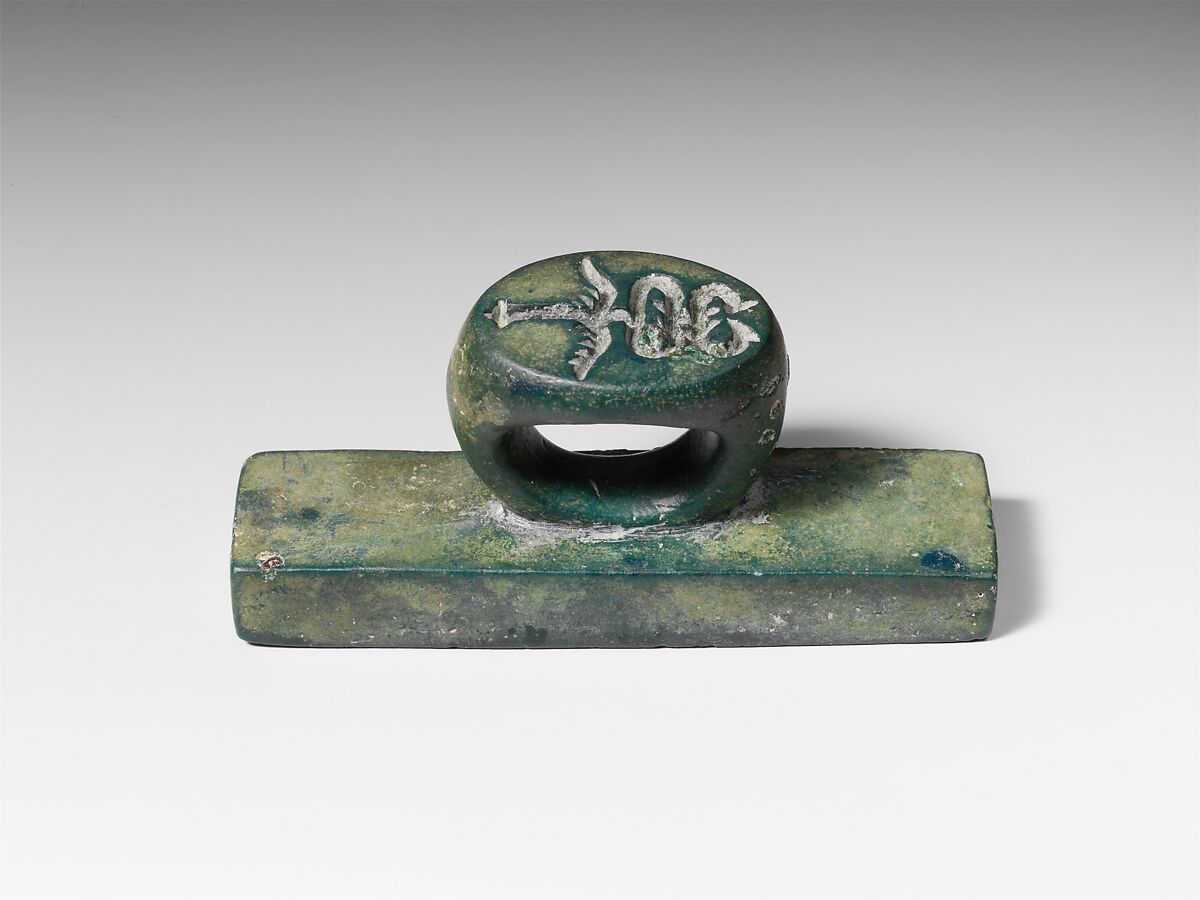
A Roman stamp and the physical world of impressions
The Met dates this bronze stamp to the first century CE (approximately 1–100 CE). Its letters abbreviate the name Lucius Herennius Florus; the museum proposes that it marked household provisions. Compare the physical relationship between a stamp and an impression with the representation language in Hebrews 1:3. This object offers a material comparison. Hebrews names no particular tool, owner or workshop, and the image cannot settle every philosophical or theological question about the wording.
Explore the historical sourceResearch PathsCurated links for exploring this chapter 3
Language & Literature2
- Explore Hebrews’ authorship and literary formYale Bible Study · Hebrews
The scholarly course introduces the unknown author and audience and the description of Hebrews as a word of exhortation. Evaluate specific reconstructions as arguments rather than treating a traditional attribution as a named signature.
- Hebrews 1: translation and textual notesNET Bible
Compare the KJV with the translation and notes, distinguishing Greek readings, translation decisions and historical proposals.
Artifacts & Manuscripts1
- Compare scriptural texts in a Greek Bible manuscriptCodex Sinaiticus Project · partner manuscript institutions
Explore the Psalms and Hebrews through See the Manuscript. This fourth-century witness makes Greek copying and book arrangement visible; it is later than Hebrews’ composition and is not the author’s own source copy.
Explore the full chapter collection
Directory Members can explore all the available questions, closer-look items, and curated links for this chapter.
Public Discussion
Your display name and comment can be seen by anyone visiting this chapter. Do not include private or sensitive information. Read the Community Guidelines.
You must be logged in to post a comment.