

The Bible Directory · Ancient Religious Worlds
Asherah: Goddess, Inscriptions and Cult Objects
Meet Asherah
Asherah’s story connects divine motherhood with the pursuit of blessing and protection. Known as Athirat in Ugaritic texts, she belonged to the senior divine household; later inscriptions from Israel and Judah reveal how the name asherah figured in appeals for divine favor.
Who was Asherah?
In Ugarit’s stories, Athirat is a senior goddess associated with El and the family of gods. Scholars connect her with Asherah, while also tracing how her place in religious life changed across communities.
What was she known for?
Ugaritic stories emphasize divine motherhood and nurturing. Later inscriptions bring blessing into view. These different settings give us a fuller picture than a single label such as “fertility goddess.”
Why was she worshiped?
People appear to have sought blessing, protection and divine care. Inscriptions offer small glimpses of those hopes, rather than a complete account of every worshiper’s wishes.
How did people relate to her?
Blessing formulas suggest people turning toward divine help. Biblical writers often take an opposing view of the worship. Reading these voices together helps us explore the relationship without assuming everyone experienced it in the same way.
What did worship involve?
Inscriptions invoke blessing with asherah, and biblical passages describe sacred objects being set up or removed. Scholars continue to explore how the goddess, her symbols and local practices were connected.
What survives from the ancient world?
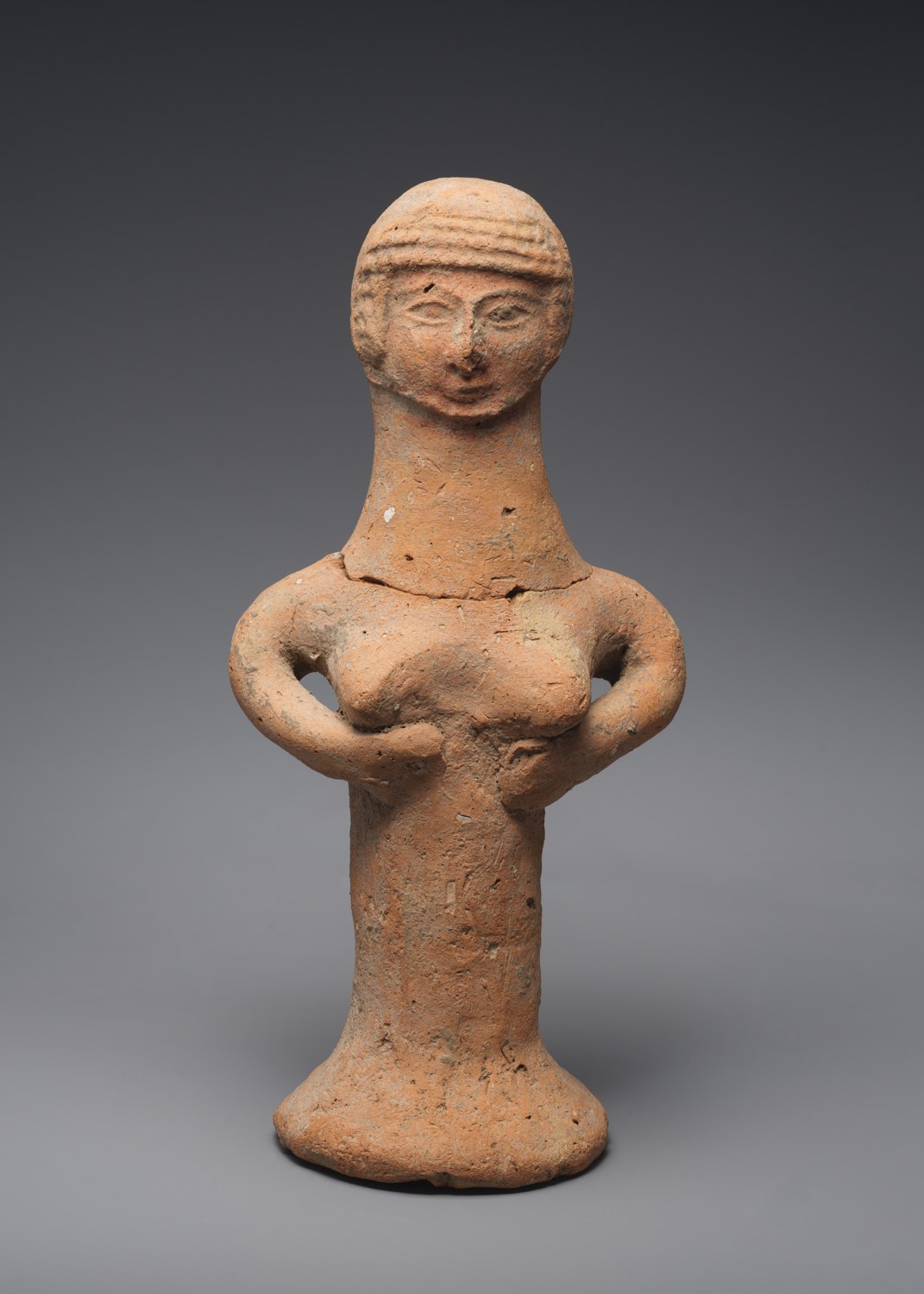
The trail includes Ugaritic stories, inscriptions from Kuntillet ‘Ajrud and Khirbet el-Qom, biblical passages and archaeological finds. The figurine below is sometimes connected with Asherah, but it has no inscription naming her.
Explore the sources
Explore the objects, writings and questions below.
Begin by separating three kinds of source
At Ugarit, the goddess usually rendered Athirat belongs to a divine world in which El holds senior authority. Scholars connect her name with Hebrew Asherah, but a shared name does not establish identical beliefs across different centuries and communities.
Hebrew biblical passages also use forms of asherah for something that can be made, erected, cut down or burned. In many contexts a cult object is in view. Which passages refer directly to a goddess, and how an object related to her, require individual examination.
Documents to investigate
Ugaritic narrative: consult the palace negotiations in KTU 1.4 in a scholarly translation of the Baal Cycle. Attend to Athirat’s role in approaching El rather than reducing her to a modern label such as “fertility goddess.” The linked SBL edition is available through libraries or purchase; it is not free full text.
Iron Age inscriptions: texts from Kuntillet ‘Ajrud, around 800 BCE, and Khirbet el-Qom, in the eighth century BCE, connect YHWH with a term commonly transcribed as “his asherah.” These are later and geographically distinct from Ugarit’s archive.
Judith Hadley’s open scholarly discussion examines readings, historical context and the relationship between inscriptions and biblical passages. Peter Stein’s WiBiLex article provides a further treatment in German, with illustrations and bibliography. Read their arguments as arguments, including where their interpretations differ.
An artifact to inspect
The Met’s Nude female figure, 34.126.53, is a ceramic pillar figurine from Lachish, dated approximately to the eighth–seventh centuries BCE. It supplies a concrete example for studying religion and small objects in Iron Age Judah.
The object does not carry a label naming Asherah. Identifying Judean pillar figurines with that goddess is an interpretation, not a fact established by this figure alone. The museum discusses a possible association; this page retains the distinction.
Nor should figures drawn beside an inscription automatically be identified as the deities mentioned in its wording. Establish the relationship between image, inscription and archaeological setting before proposing an identification.
Biblical passages and translation
Compare Deuteronomy 16, Judges 6, 1 Kings 18 and 2 Kings 23. Ask what actions are performed and whether the passage describes people, an image, an installation or more than one of these. The Directory uses the KJV, where “grove” or “groves” can conceal the Hebrew term relevant to this question.
Asherah and Astarte/Ashtoreth are not interchangeable names to merge without argument. Similar spellings in English and overlapping modern descriptions can obscure distinctions among ancient figures and terms.
Where scholars disagree
A goddess interpretation of the inscriptional expression has substantial scholarly support; how to understand the possessive form, cult symbol and local practice remains discussed. Do not imply that all proposals are equally supported, or that the inscriptions settle every question about the official religion of Israel and Judah.
Household objects, local blessings and biblical prohibitions speak from different settings. One cannot simply substitute for the others. Our surviving material is uneven and rarely gives direct access to what an individual worshipper believed.
Try it yourself
Choose one inscription and one biblical passage. List the words or actions each preserves; then list what is reconstructed. Finally inspect the figurine: what can you describe without naming a deity?
Research Paths
Judith M. Hadley · study of Asherah
Open scholarly essay · inscriptions, Hebrew terminology and contested historical reconstructions. The linked article uses its original academic title.
Peter Stein · Aschera, WiBiLex
German scholarly reference · goddess, cult objects, inscriptions and interpretation.
The Met · Nude female figure from Lachish
Museum record · inspect the object while distinguishing its catalogue description from a proposed divine identity.
Ugaritic Narrative Poetry · Simon B. Parker, editor
English translation edition · library or purchase access, not free full text. Includes Baal, Kirta and Aqhat; locate the tablet numbers identified above. Modern translations remain copyrighted.
Read the related chapters
Keep exploring
Temples, ritual and sacred objects →