

The Bible Directory · Ancient Religious Worlds
Chemosh: Moab, Kingship and the Mesha Stele
Meet Chemosh
Chemosh stood at the center of Moab’s royal story. Mesha credited him with the recovery of territory, the defeat of enemies and the renewal of his kingdom—binding divine favor to a people’s fortunes and a king’s claim to rule.
Who was Chemosh?
A major god of Moab, also written Kemosh. The Mesha Stele names him repeatedly in a Moabite king’s account of his reign.
What was he known for?
The inscription associates him with Moab’s fortunes and victory. This does not establish a separate natural domain such as rain or the sun.
Why was he worshiped?
Mesha credits Chemosh with deliverance and commemorates a sanctuary for him. That royal voice gives us a specific reason for honoring the god.
How did people relate to him?
Mesha’s account presents both divine anger and renewed favor. It cannot tell us how every Moabite understood or experienced the relationship.
What did worship involve?
The stele connects sanctuary building and the dedication of captured objects with Chemosh. It is not a complete ritual handbook.
What survives from the ancient world?
A named royal inscription, biblical references and archaeological material from Moab. The pictured monument contains writing; it supplies no portrait of Chemosh.
Explore the sources
Explore the objects, writings and questions below.
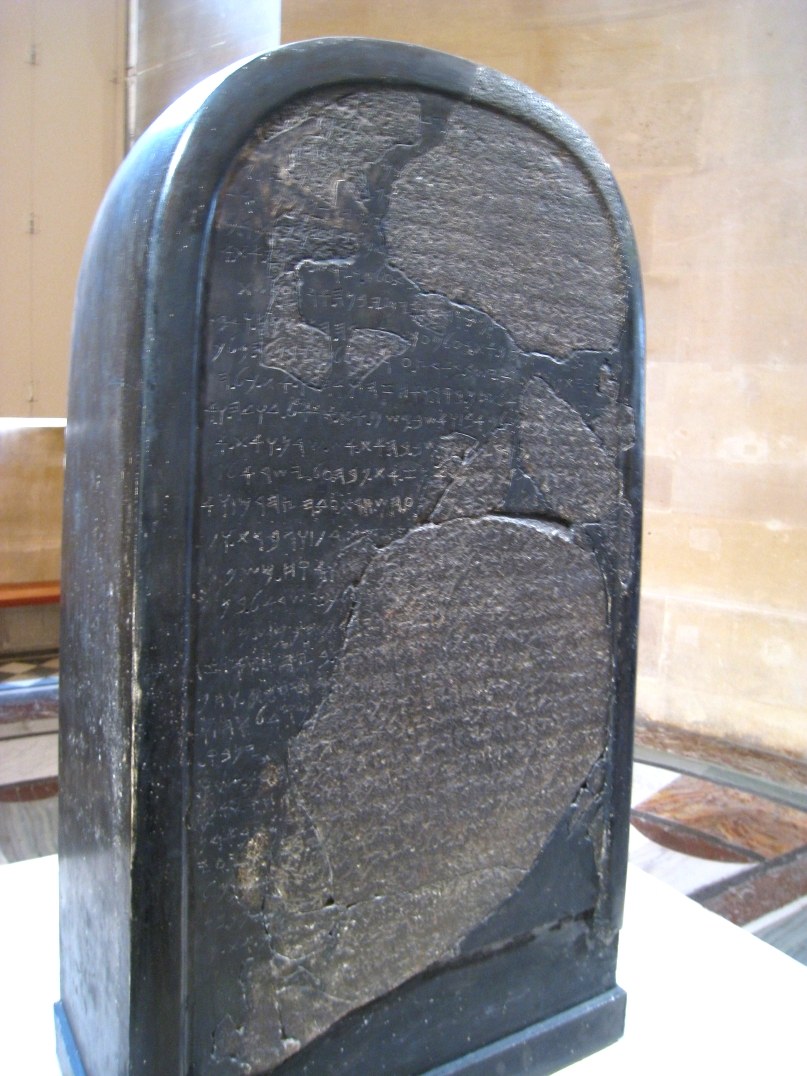

Explore Chemosh through ancient writing, surviving objects and the questions they leave us.
A Moabite king speaks
The Louvre’s record of the Mesha Stele identifies a ninth-century BCE basalt inscription from Dhiban. Its text commemorates territorial recovery and a sanctuary. The monument is incomplete, repaired and restored: the object on display combines ancient fragments with reconstructed areas.
Documents to investigate
Read K. C. Hanson’s English translation and compare the version published by Livius, adapted from Klaas Smelik. Follow the opening account of defeat and recovery. Where does the king describe his own actions, and where does he attribute events to Chemosh? These are royal claims, not independent confirmation of divine intervention.
Worth a closer look
Inspect the museum photographs and object description. Compare the visible lines with the translation, paying attention to missing passages. A readable modern reconstruction is a scholarly aid; it should not make a damaged stone appear to preserve every word intact.
Victory, devotion and the limits of a royal text
The inscription includes accounts of killing and dedication in warfare. Read that language in its royal commemorative setting. A ruler’s monument can present violence as devotion while telling us little about household prayers, local variations or the experiences of people who suffered in the conflict.
Connections to the Bible
Numbers 21 and Jeremiah 48 associate Chemosh with Moab, while 1 Kings 11 includes him among neighboring deities. Second Kings 3 tells of a campaign against Mesha and a royal sacrifice. Its narrative is not a duplicate of the stele, and the sacrificial episode itself does not name Chemosh. Compare the different voices before trying to align events.
Try it yourself
Make two columns: what the monument physically preserves, and what its royal speaker claims. Add a third for what the biblical passages say. Which questions can you answer from more than one kind of source? Which remain dependent on a single speaker?
Research Paths
K. C. Hanson · read the Mesha Stele translation · Louvre · monument AO 5066 and bibliography · Livius · another translation and historical introduction
Read the related chapters
Keep exploring
Explore Moab, Ammon and Edom →
Temples, ritual and sacred objects →