

The Bible Directory · Ancient Religious Worlds
Baal: Storm, Kingship and the Ancient Texts
Meet Baal
Baal’s storms meant more than weather: rain sustained the harvest and the communities that depended on it. At Ugarit, his struggles for divine kingship linked the land’s survival with the contest for power among the gods.
Who was Baal?
At Ugarit, Baal was a powerful storm deity whose stories concern struggles for kingship. His name means “lord.” Other places and periods had their own Baal traditions.
What was he known for?
Rain, dew and the growth that sustained people and animals. His Ugaritic stories also connect him with divine rule. He was more than a god assigned one simple job.
Why was he worshiped?
They sought the rain that made harvests possible and the protection of a powerful divine patron. This connects worship with practical concerns about food, survival and community security.
How did people relate to him?
The texts present a life-sustaining provider, not merely a frightening enemy. Hope for help and anxiety about its absence could coexist; we cannot recover every worshipper’s feelings.
What did worship involve?
Ugaritic offering lists and ritual texts record worship, and archaeology identifies a temple associated with Baal. Those sources tell us about practices; a mythic battle is not automatically a ceremony people performed.
What survives from the ancient world?
Clay tablets, ritual lists, temple archaeology and images such as the Louvre stele. Biblical authors supply another perspective, often opposing Baal worship; that is different from a worshipper’s own account.
Explore the sources
Explore the objects, writings and questions below.

Begin with a place and a period
At Late Bronze Age Ugarit, on the coast of what is now Syria, Baal is a storm deity associated with rain and divine kingship. The name also comes from a word meaning “lord” or “owner.” A title shared across communities does not guarantee one unchanged divine identity. Follow the scholarly overview below.
Ugarit’s texts belong to the second millennium BCE. Israelite and Judahite biblical settings and inscriptions often concern the first millennium BCE. Keep that chronological distance visible when comparing them. The literary world of a palace archive is also different from a household’s religious practice.
Documents to investigate
The Baal Cycle is conventionally identified as KTU 1.1–1.6. Its surviving episodes concern conflict with Yamm (Sea), the construction of Baal’s palace, and encounters with Mot (Death). It is not simply a complete account of the creation of the world.
Read an actual passage: the French Ministry of Culture’s Ugarit resource presents KTU 1.2 IV, with a French translation credited to Pierre Bordreuil and Dennis Pardee. Look for the named weapons and the movement from conflict toward kingship. The translation is French; the page is not a complete English edition.
For an English edition, use Ugaritic Narrative Poetry below. Ask which tablet and column a claim comes from. A damaged clay tablet may preserve only part of a speech; a modern summary can hide those gaps.
Objects and places to inspect
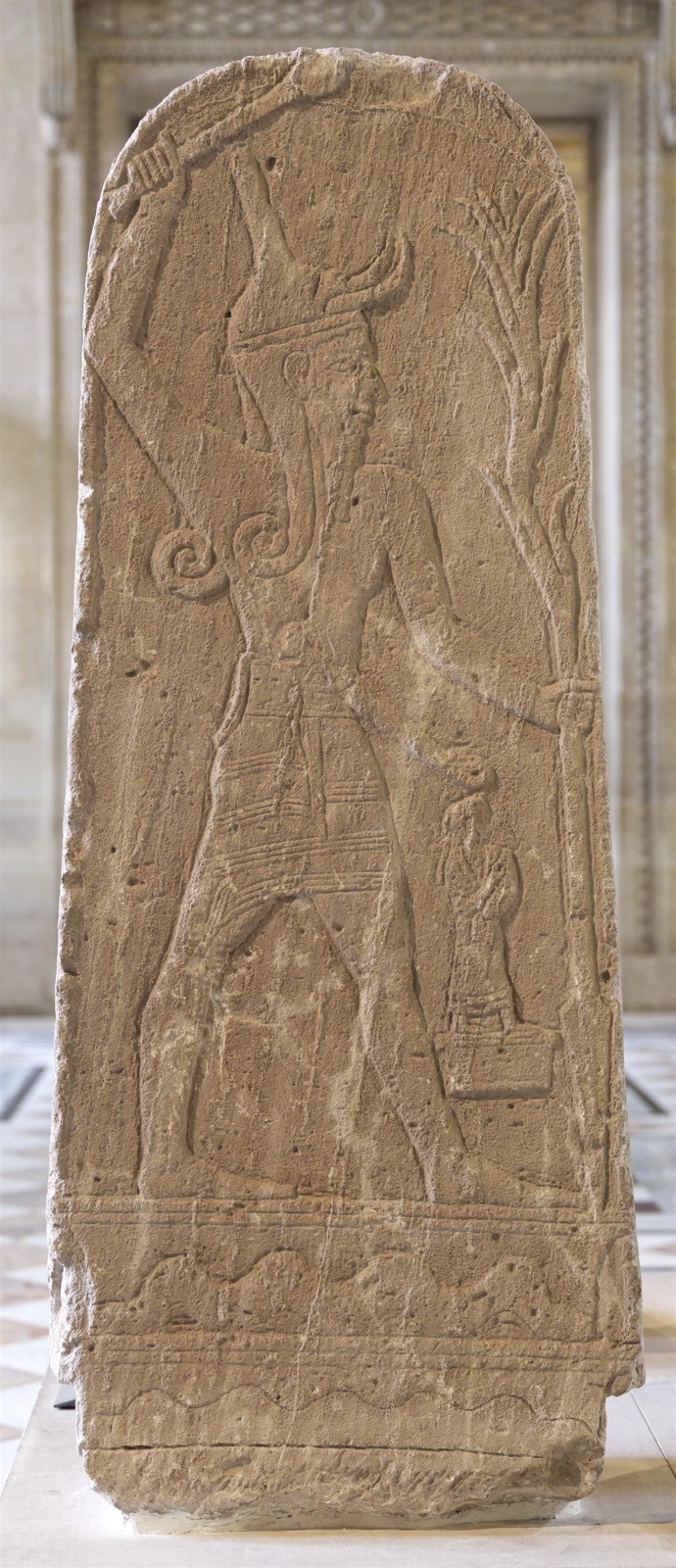
The Louvre’s Baal with Thunderbolt stele, AO 15775, comes from Ras Shamra/Ugarit. Compare the raised arm, weapon and smaller accompanying figure with the museum’s record. A relief and a poem offer different kinds of information.
The photograph above shows the Louvre’s Baal with Thunderbolt stele, AO 15775. This is a museum-identified depiction of Baal, rather than an unnamed figure selected only because its pose looks similar. The photograph is credited and licensed separately from the ancient object.
Use the excavation project’s publication on the temples of Baal and Dagan to pursue the architectural setting. This is a publication record, not an English translation of a temple ritual.
Where scholars disagree
How should the episodes involving Mot be related to seasonal change, kingship and ritual? The interpretation and reconstruction of the cycle remain subjects of discussion. A simple label such as “fertility god” leaves out much of the material.
Biblical accounts such as 1 Kings 18 are crafted narratives with a position on legitimate worship. Read their portrayal of Baal on its own terms, then compare it with Ugaritic sources. Neither source is a neutral survey of every ancient worshipper.
Try it yourself
Make three notes: what the translated tablet actually says; what the stele visibly shows; and what you infer by comparing them. Mark the inference separately. Then read 1 Kings 18 and Hosea 2 in context: which claims concern rain, allegiance or religious authority?
Research Paths
Sebastian Grätz · Baal, WiBiLex
German scholarly reference · terminology, local forms, texts and competing interpretations.
Robert Hawley · The Baal Cycle
French Ministry of Culture · free translated excerpt, KTU 1.2 IV, and literary introduction.
Louvre · Baal with Thunderbolt
Museum object record · AO 15775; examine the object and its find context.
Ugaritic Narrative Poetry · Simon B. Parker, editor
English translation edition · library or purchase access, not free full text. Includes Baal, Kirta and Aqhat; locate the tablet numbers identified above. Modern translations remain copyrighted.
Read the related chapters
Keep exploring
Temples, ritual and sacred objects →