

The Bible Directory · Ancient Religious Worlds
Artemis: The Hunt, Ephesus and Ancient Sources
Meet Artemis
Artemis could be encountered in a mountain hunt or at the heart of a powerful city. Her images and sanctuaries reveal why a goddess cannot be understood through one symbol or one place alone.
Who was Artemis?
A Greek goddess associated with the hunt and wild animals, commonly presented as Apollo’s sister. Artemis at Ephesus had a distinctive local image and civic importance.
What was she known for?
Archery, wild landscapes and hunting in Hymn 27. Her Ephesian sanctuary also belonged to the religious, social and economic life of a major city.
Why was she worshiped?
Her worship expressed honor toward a powerful goddess and attachment to local sacred traditions. The concerns of a sanctuary community cannot be reconstructed from mythology alone.
How did people relate to her?
Hymn 27 presents formidable hunting power, then music and dance at Delphi. These portraits bring together force, delight and divine honor.
What did worship involve?
Prayers, offerings and sanctuary festivals were part of Greek religious life. Archaeological research at Ephesus examines the sacred precinct and its wider infrastructure.
What survives from the ancient world?
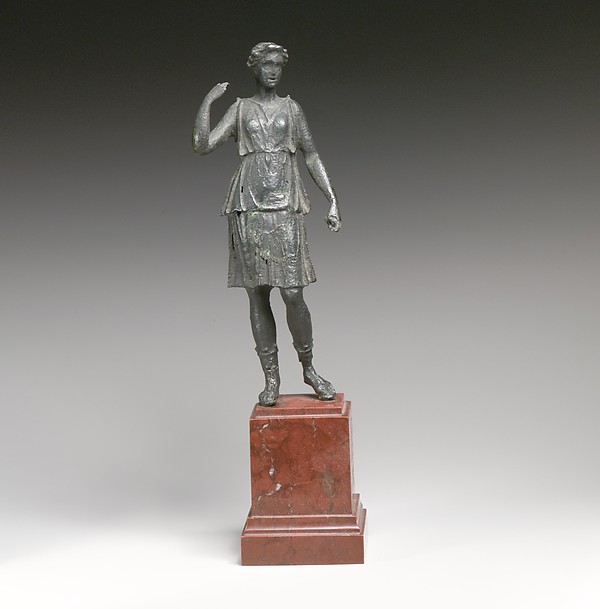
Hymns, statues, inscriptions, coins and sanctuary archaeology. The bronze here depicts a huntress; it is not the distinctive Ephesian cult statue mentioned in discussions of Acts 19.
Explore the sources
Explore the objects, writings and questions below.
Follow the hymn beyond the hunt
Homeric Hymn 27 begins with Artemis drawing her bow in the mountains. It then takes her to Delphi, where she sets aside her weapons and leads a dance. A source that starts with hunting ends in a different scene.
Compare those movements with the bronze statuette. Literature and sculpture select aspects of a deity for different purposes; neither is a complete catalogue of local beliefs.
The image on this page
The Met identifies this bronze as Artemis reaching toward a quiver once suspended over her right shoulder. Her other hand probably held a bow. Her short clothing and boots fit the huntress’s movement.
The missing bow matters: part of the interpretation reconstructs an attribute no longer present. Preserve the museum’s distinction between what survives and what probably once accompanied it.
Artemis at Ephesus
Acts 19:23–41 connects Artemis’s Ephesian sanctuary with silversmiths, civic identity and a public disturbance. The KJV calls the goddess Diana; the Greek text uses Artemis. That familiar Roman name should not obscure the particular Ephesian setting.
The Austrian Academy’s Temenos and Territory project investigates the sanctuary’s precinct, property and infrastructure. This offers a different kind of source beside Acts: archaeological study of an institution’s place in the city and landscape.
The huntress shown here should not stand in as a photograph of the Ephesian cult image. Local iconography matters even when the divine name is shared.
Research Paths
Homeric Hymn 27 to Artemis · English primary text ↗
Perseus / Tufts · hunting, Delphi and divine celebration.
The Met · Bronze statuette of Artemis ↗
Museum record · third–first century BCE; posture, costume and missing attributes.
Austrian Academy of Sciences · Temenos and Territory ↗
Archaeological research · the Artemision at Ephesus and its social, spatial and economic setting.
Read the related chapters
Keep exploring
Temples, ritual and sacred objects →