
The Greek and Hellenistic World
Explore the cities, royal kingdoms and Greek-speaking networks that connected the Mediterranean with the biblical world.
MEMBER RESEARCH EDITIONSee the additional member research ↓
Greece: cities, conquests and an enduring intellectual world
Greek city-states produced influential traditions of poetry, philosophy, political thought and art while competing for power across the Mediterranean. Athens built a maritime empire; Sparta led its rivals. Macedonia then transformed the political landscape. Alexander’s campaigns, beginning in 334 BCE, overthrew Persian dynastic rule and carried Greek-speaking armies and royal institutions from the Aegean to Egypt and deep into Asia.
His empire fragmented after his death in 323 BCE, but the connections outlasted him. Rival kingdoms fostered cities and scholarship, including Alexandria’s Library and Mouseion. Jewish scripture entered Greek through translations begun in Ptolemaic Egypt; Greek later became the language of the New Testament. Rome absorbed the kingdoms, while Greek literature, philosophy and scientific inquiry continued to shape later intellectual traditions.
Timeline: cities, conquests and changing kingdoms
- Greek city-states and Mediterranean exchange
Archaic communities develop distinctive institutions and far-reaching contacts.
- Wars with Persia
Greek victories precede the growth of Athenian maritime power.
- Athens and Sparta at war
The Peloponnesian War ends in Athens’s defeat.
- Macedonia dominates Greece
Philip II defeats Athens and Thebes at Chaeronea.
- Alexander conquers the Persian empire
Campaigns link Greece, the Levant, Egypt and the Iranian heartland.
- Successors struggle for power
Ptolemaic, Seleucid and Antigonid kingdoms emerge over time; the map below shows a stage around 300 BCE.
- The Torah is translated into Greek
Jewish translation in Ptolemaic Egypt begins a longer history of Greek scripture.
- Judea changes imperial rulers
Antiochus III’s victory at Panion leads to Seleucid control.
- Revolt and temple rededication
Conflict under Antiochus IV leads to the Maccabean revolt; the temple is rededicated in 164.
- Hasmonean political autonomy
Simon’s leadership marks a major step toward independent government.
- Pompey intervenes in Judea
Rome becomes the dominant outside power.
- Ptolemaic Egypt comes under Rome
Actium is followed by the end of Cleopatra VII’s rule and Roman annexation.
Selected rulers and their dates
This is a selected list, not a continuous royal succession. Different kingdoms existed at the same time; dates identify reigns, with royal titles distinguished where needed.
- Philip II of Macedonia359–336 BCE
- Alexander III336–323 BCE
- Ptolemy I Soter305–282 BCE as king; governor in Egypt from 323
- Seleucus I Nicator305–281 BCE as king
- Ptolemy III Euergetes246–221 BCE
- Antiochus III223–187 BCE
- Antiochus IV Epiphanes175–164 BCE
- Alexander Jannaeus103–76 BCE; Hasmonean king and high priest
- Cleopatra VII51–30 BCE
Locate the kingdoms after Alexander
This map shows one stage of the struggle among Alexander’s successors. Find Egypt, the Levant and Macedonia; their rulers and boundaries continued to change.
Hellenistic successor kingdoms around 300 BCE
After Alexander’s death in 323 BCE, his conquests did not remain a single empire. By about 300 BCE, successor rulers controlled competing kingdoms across the eastern Mediterranean and western Asia. The map places Judea within the Ptolemaic realm while showing the larger Seleucid kingdom to the north and east—the rivalry that later made the southern Levant a repeatedly contested corridor.
Map: Morningstar1814, after Luigi Chiesa and William R. Shepherd · CC BY-SA 4.0 · source and license ↗Look closely at the surviving records
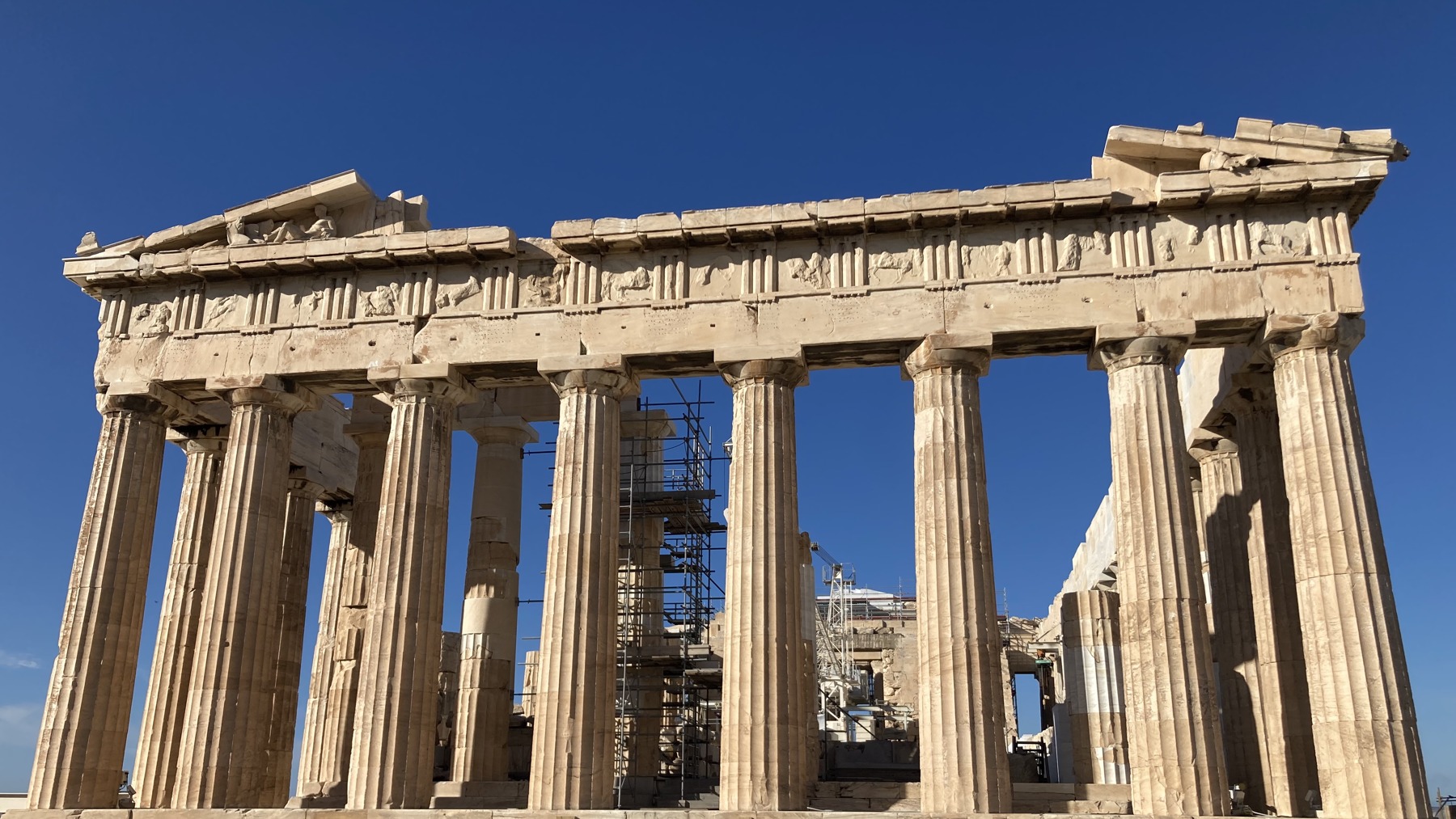
The Parthenon: Athens makes its power visible
447–432 BCE · Acropolis, Athens · modern photograph of the surviving temple
Dedicated to Athena, the Parthenon formed part of the great fifth-century Athenian building program. Its architecture and sculpture connect religion, civic identity and the resources of an imperial city.
What to notice: The columns frame an open interior today. Scaffolding belongs to modern conservation; this photograph does not reconstruct the ancient building.
Photograph: C. Skaug, 2026. CC BY-SA 4.0. The photographer reports minor retouching at the bottom; proportionally resized here, with no additional crop. Image source · CC BY-SA 4.0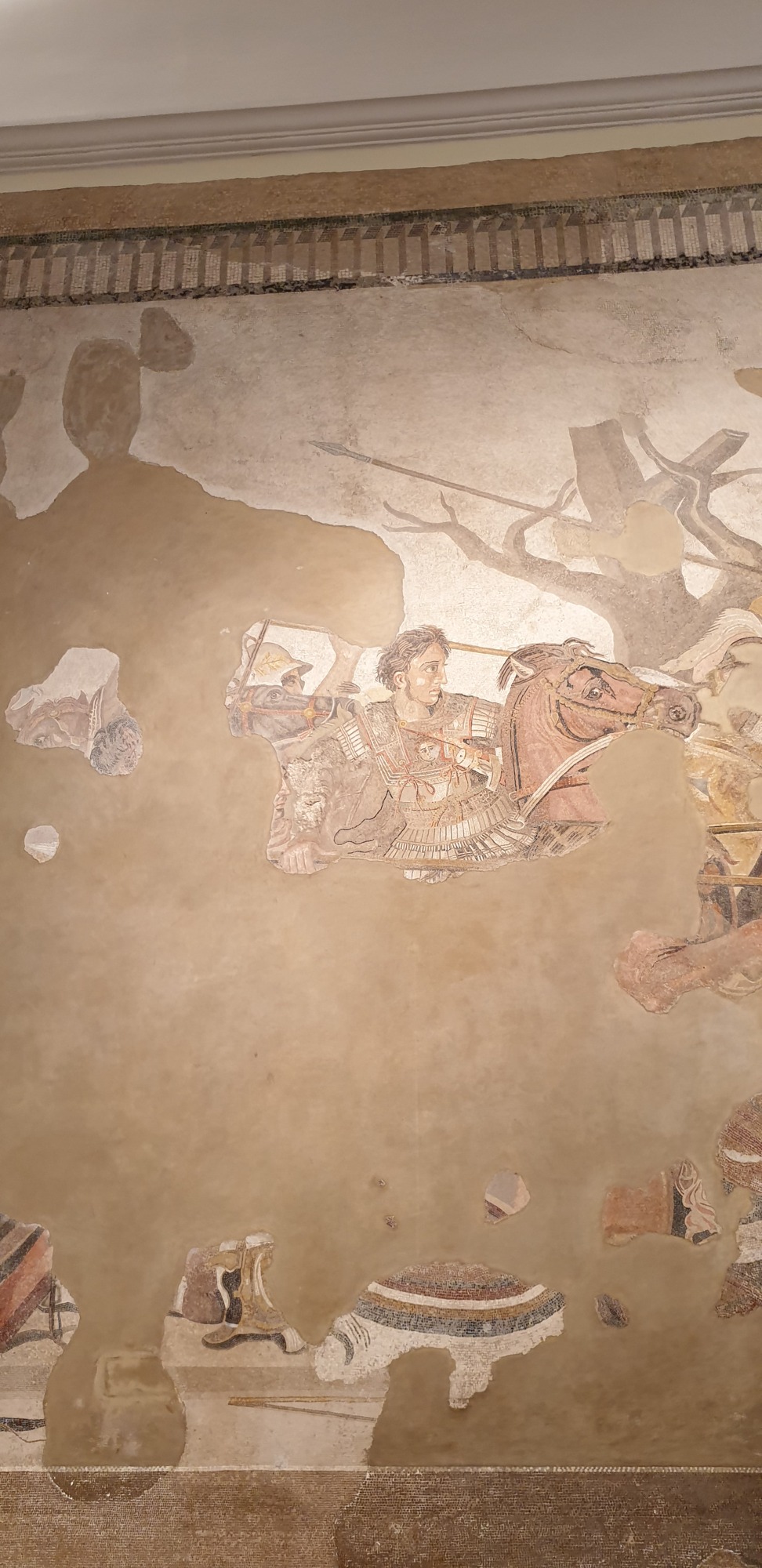
Alexander: a victory remembered in mosaic
Late second century BCE · House of the Faun, Pompeii · National Archaeological Museum of Naples
The mosaic depicts Alexander confronting Darius III, generally associated with the battle of Issus. Made long after the campaign, it preserves a later image of the conqueror in a wealthy Pompeian household.
What to notice: Alexander appears on horseback in this detail. The large pale areas are losses in the surviving mosaic, not its complete ancient design.
Photograph: Jamie Heath, 2019. CC BY-SA 2.0. Proportionally resized; no additional crop. This photograph shows a detail, not the complete mosaic. Image source · CC BY-SA 2.0