

The Bible Directory · Ancient Religious Worlds
Hermes: Messengers, Movement and Ancient Sources
Meet Hermes
Hermes carried messages and crossed boundaries. Ancient stories make his quick thinking as important as his speed, connecting divine communication with travel, exchange, flocks and the unexpected turns of human life.
Who was Hermes?
A Greek god and divine messenger, traditionally the son of Zeus and Maia. His roles include movement between places and the skill of negotiating encounters.
What was he known for?
Messages, journeys, flocks and cunning. The long Homeric Hymn portrays a remarkably resourceful infant who invents a lyre and steals Apollo’s cattle.
Why was he worshiped?
He could be approached as a source of good fortune and assistance. Specific local offerings are needed to reconstruct which concern mattered in an individual act of worship.
How did people relate to him?
His hymn makes him both helpful and disruptive. The story’s humor and deception are part of its literary portrait, not a complete description of ritual relationships.
What did worship involve?
Greek worship involved prayers and offerings in particular settings. The tale of Hermes dividing meat into twelve portions is a mythic episode, not an instruction to reproduce every action.
What survives from the ancient world?
Literary hymns, representations, dedications and sanctuary material. Museum catalogues help distinguish a named Hermes image from an unidentified youthful figure.
Explore the sources
Explore the objects, writings and questions below.
A messenger with more than one role
The opening of Homeric Hymn 4 places Hermes in Arcadia and introduces him through quick-changing skills. The narrative moves from a tortoise-shell lyre to the theft of Apollo’s cattle. Follow the actions before reducing the god to a single label such as “messenger.”
The Met’s separate Arcadian statuette carries a lamb. That record provides an object-based comparison for the connection with flocks; it also shows why a divine role may be much broader than the most familiar modern illustration.
What identifies this image?
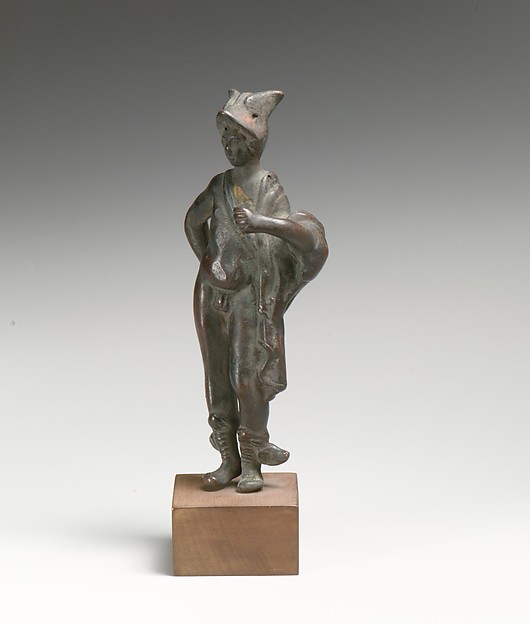
The bronze shown here is catalogued as Hermes. The museum notes wings attached to his feet and his petasos, a broad-brimmed hat. Its date is first century BCE–second century CE, and its culture is listed as Greek or Roman.
Keep that uncertainty visible. The museum names the figure while allowing a range for its cultural setting. “Named deity” and “precisely known production context” are separate claims.
Mercurius in an English Bible
Acts 14:12 describes Paul as the principal speaker and uses the Greek name Hermes. The KJV renders it Mercurius; it calls Barnabas Jupiter where the Greek has Zeus. Search and navigation should help readers recognize both sets of names.
Roman Mercury was closely identified with Hermes, but Roman worship had its own institutions and settings. This guide follows Hermes while making that connection explicit. Compare the Zeus guide →
Research Paths
Homeric Hymn 4 to Hermes · Read lines 1–140 ↗
Perseus / Tufts · English primary text; continue through the viewer for the rest of the hymn.
The Met · Bronze statuette of Hermes ↗
Museum record · Greek or Roman, first century BCE–second century CE.
The Met · An Arcadian Hermes carrying a lamb ↗
Museum account · a sixth-century BCE comparison emphasizing flocks. No photograph is currently supplied in that record.
Read the related chapters
Keep exploring
Temples, ritual and sacred objects →