
Acts 14
1 And it came to pass in Iconium, that they went both together into the synagogue of the Jews, and so spake, that a great multitude both of the Jews and also of the Greeks believed.
2 But the unbelieving Jews stirred up the Gentiles, and made their minds evil affected against the brethren.
3 Long time therefore abode they speaking boldly in the Lord, which gave testimony unto the word of his grace, and granted signs and wonders to be done by their hands.
4 But the multitude of the city was divided: and part held with the Jews, and part with the apostles.
5 And when there was an assault made both of the Gentiles, and also of the Jews with their rulers, to use them despitefully, and to stone them,
6 They were ware of it, and fled unto Lystra and Derbe, cities of Lycaonia, and unto the region that lieth round about:
7 And there they preached the gospel.
8 And there sat a certain man at Lystra, impotent in his feet, being a cripple from his mother's womb, who never had walked:
9 The same heard Paul speak: who stedfastly beholding him, and perceiving that he had faith to be healed,
10 Said with a loud voice, Stand upright on thy feet. And he leaped and walked.
11 And when the people saw what Paul had done, they lifted up their voices, saying in the speech of Lycaonia, The gods are come down to us in the likeness of men.
12 And they called Barnabas, Jupiter; and Paul, Mercurius, because he was the chief speaker.
13 Then the priest of Jupiter, which was before their city, brought oxen and garlands unto the gates, and would have done sacrifice with the people.
14 Which when the apostles, Barnabas and Paul, heard of, they rent their clothes, and ran in among the people, crying out,
15 And saying, Sirs, why do ye these things? We also are men of like passions with you, and preach unto you that ye should turn from these vanities unto the living God, which made heaven, and earth, and the sea, and all things that are therein:
16 Who in times past suffered all nations to walk in their own ways.
17 Nevertheless he left not himself without witness, in that he did good, and gave us rain from heaven, and fruitful seasons, filling our hearts with food and gladness.
18 And with these sayings scarce restrained they the people, that they had not done sacrifice unto them.
19 And there came thither certain Jews from Antioch and Iconium, who persuaded the people, and, having stoned Paul, drew him out of the city, supposing he had been dead.
20 Howbeit, as the disciples stood round about him, he rose up, and came into the city: and the next day he departed with Barnabas to Derbe.
21 And when they had preached the gospel to that city, and had taught many, they returned again to Lystra, and to Iconium, and Antioch,
22 Confirming the souls of the disciples, and exhorting them to continue in the faith, and that we must through much tribulation enter into the kingdom of God.
23 And when they had ordained them elders in every church, and had prayed with fasting, they commended them to the Lord, on whom they believed.
24 And after they had passed throughout Pisidia, they came to Pamphylia.
25 And when they had preached the word in Perga, they went down into Attalia:
26 And thence sailed to Antioch, from whence they had been recommended to the grace of God for the work which they fulfilled.
27 And when they were come, and had gathered the church together, they rehearsed all that God had done with them, and how he had opened the door of faith unto the Gentiles.
28 And there they abode long time with the disciples.
World Behind This Chapter
Explore the people, places, language, history, and material world connected to Acts 14.
What does the move from Iconium to Lycaonia establish?
Acts 14:1–7 distinguishes Iconium from the Lycaonian towns reached after a threat. Ancient regional identity and Roman administrative boundaries did not always coincide. Use period-specific geography before alleging an error or claiming that a modern map settles every boundary question. The account supplies movement and town names, not a complete provincial gazetteer.
Why do the KJV and modern editions use different divine names?
Acts 14:11–13 calls Barnabas Zeus and Paul Hermes in Greek; the KJV uses the Roman equivalents Jupiter and Mercurius. Compare the language of the crowd and the explanation that Paul was the principal speaker. The paired names are culturally meaningful, but the text does not identify every feature of the local cult or a surviving statue.
Does Ovid’s visitor story explain the crowd’s response with certainty?
Ovid’s Metamorphoses 8 tells of Jupiter and Mercury visiting the home of Baucis and Philemon in a Phrygian setting. It offers a comparison for traditions about gods appearing as travelers. Acts does not say the Lystra crowd knew that particular poem or story. Similarity introduces a question; it does not establish direct literary dependence.
WORTH A CLOSER LOOK
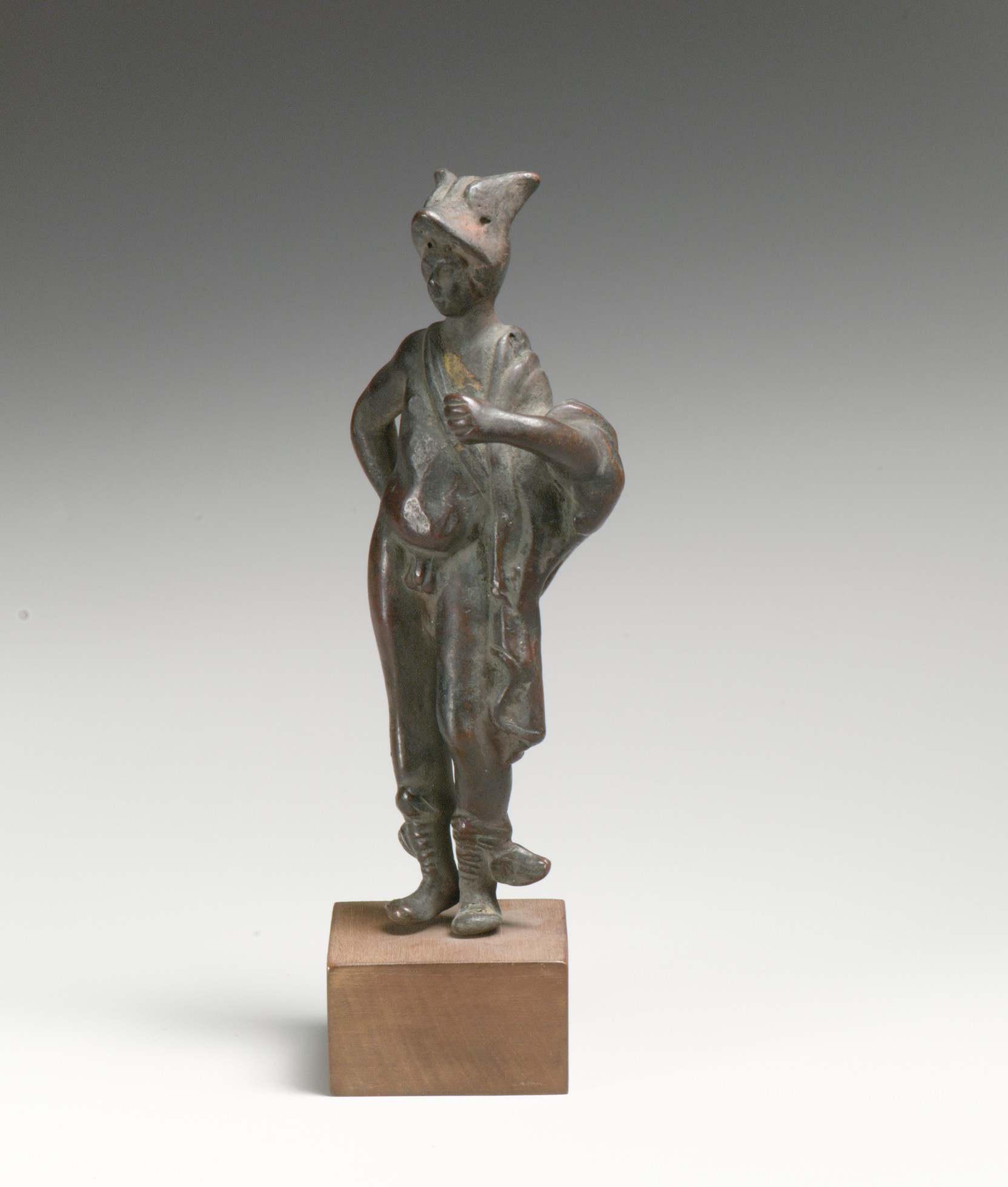
How an ancient artist represented Hermes
Bronze statuette of Hermes · first century BCE to second century CE · Metropolitan Museum of Art, 97.22.1. Look for wings attached to the hat and feet, features associated with the messenger god. This object offers visual context for the name Hermes in Acts 14. It is not from the narrated Lystra encounter, does not depict Paul and cannot reconstruct the local cult by itself.
Explore the historical sourceResearch PathsCurated links for exploring this chapter 3
History & Daily Life1
- Read Ovid’s account of Baucis and PhilemonTheoi Classical Texts Library · Ovid, Metamorphoses 8, translated by Brookes More
Locate the Baucis and Philemon section, around lines 611–724. This ancient literary comparison involves Jupiter and Mercury in Phrygia; it does not demonstrate that the Lystran audience knew the story or that Acts copied it.
Maps & Timeline1
- Explore Iconium, Lystra and the return routeBiblePlaces · Acts 14
Use the accessible preview to compare geographical settings and proposed material parallels. Date any monuments independently and distinguish suggested associations from direct identifications.
Language & Literature1
- Acts 14: translation and narrative notesNET Bible
Compare notes on regional names, Zeus/Hermes terminology, the Lystra speech and appointments. Proposed literary parallels and exact reconstructions of community procedures remain interpretive arguments.
Explore the full chapter collection
Directory Members can explore all the available questions, closer-look items, and curated links for this chapter.
Public Discussion
Your display name and comment can be seen by anyone visiting this chapter. Do not include private or sensitive information. Read the Community Guidelines.
You must be logged in to post a comment.