

The Bible Directory · Ancient Religious Worlds
Mercury: Trade, Wealth and Ancient Sources
Meet Mercury
For people whose livelihood depended on exchange, Mercury’s favor could reach directly into daily survival. Roman images and poetry connect him with profit, movement and the uncertainties of doing business.
Who was Mercury?
Mercury was a Roman god closely identified with Greek Hermes. Roman images and observances give particular prominence to wealth and commercial life.
What was he known for?
Trade and profit, alongside the movement and communication associated with Hermes. The photographed Roman bronze carries a money pouch, making wealth visible.
Why was he worshiped?
Merchants could seek gain and protection for their business. Ovid describes sellers offering incense and asking for profit at Mercury’s May festival.
How did people relate to him?
Requests could be practical and personal. Ovid turns a merchant’s prayer into a joke about dishonest dealing; the humor should not be mistaken for every worshipper’s values.
What did worship involve?
In Fasti 5.663–692, a merchant collects water, sprinkles goods and himself with a wet laurel branch, and prays. The passage combines ritual description with comic storytelling.
What survives from the ancient world?
Small bronzes, literary accounts and household religious contexts. The Met identifies the statuette below as Roman Mercury and highlights its money pouch.
Explore the sources
Explore the objects, writings and questions below.
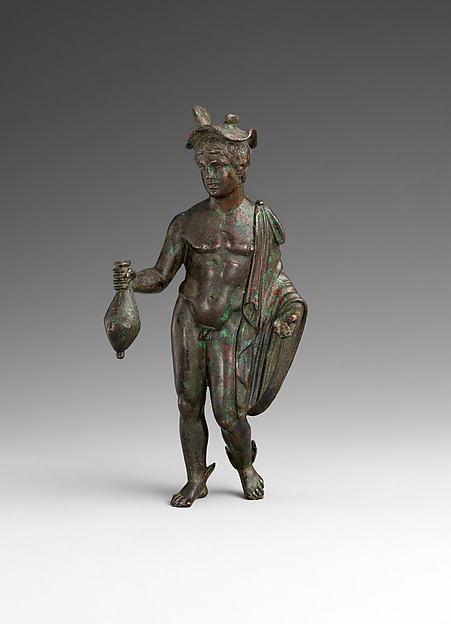
A money pouch changes the emphasis
The Met’s bronze Mercury, dated around the second century CE, combines a winged hat and ankles with a money pouch. The museum connects such figures with household shrines and the protection of wealth.
The pose also recalls Greek sculptural traditions. A Roman object can draw on Greek models while emphasizing Roman concerns; artistic borrowing does not make every religious setting interchangeable.
A merchant’s prayer—with a comic twist
Read Fasti 5.663–692 for Ovid’s May 15 observance. The poet describes incense, water and the sprinkling of merchandise before presenting an embarrassingly candid request for future profits.
This is a crafted comic scene. It can illuminate commercial hopes and religious language without proving that merchants generally prayed to cheat their customers. Notice where the account moves from describing an action to making a literary joke.
Mercurius, Hermes and Acts
Acts 14:12 uses Hermes in Greek; the KJV calls Paul Mercurius because he is the principal speaker. Its Jupiter similarly represents Greek Zeus. The episode concerns Lystra, rather than a ceremony in the city of Rome.
The Hermes guide follows Greek literary and visual traditions. This page focuses on Roman Mercury; Jupiter’s guide supplies the companion Roman name encountered in the KJV.
Small objects, everyday concerns
A portable bronze invites questions about where it stood, who used it and what other objects surrounded it. The museum’s identification provides a starting point; an individual figure’s complete ritual history cannot be recovered from appearance alone.
Research Paths
The Met · Statuette of Mercury ↗
Roman bronze, around the second century CE; image, identification and household context.
Ovid · Fasti, Book 5 ↗
English primary text · find 663–692, under May 15.
Hermes · Greek traditions and the names in Acts ↗
Internal guide · compare the Greek name and its Roman associations.
Read the related chapters
Keep exploring
Temples, ritual and sacred objects →