

The Bible Directory · Ancient Religious Worlds
Jupiter: Thunder, Civic Worship and Ancient Sources
Meet Jupiter
Jupiter’s power reached from the storm-filled sky into Rome’s public life. His favor mattered to the community, while his thunderbolt made divine authority visible in stories and images.
Who was Jupiter?
Jupiter, also called Jove, was a leading Roman god. His Capitoline title, Optimus Maximus, means “Best and Greatest.” He shared the great sanctuary on Rome’s Capitoline Hill with Juno and Minerva.
What was he known for?
Sky, lightning and supreme divine authority. The small bronze shown below combines the thunderbolt with an enthroned pose and a scepter.
Why was he worshiped?
Romans sought divine favor for their community and its public undertakings. Worship at the Capitol joined religious observance with civic identity.
How did people relate to him?
Power could inspire both alarm and confidence. Ovid’s story of Numa begins with fear of lightning and moves toward a negotiated ritual response; it is a literary account of Rome’s past.
What did worship involve?
Public sacrifice and ceremonial processions were prominent in Capitoline worship. The temple also served as a destination for triumphal celebrations.
What survives from the ancient world?
Bronze figures, architectural remains and ancient writings offer different views. A portable statuette and a monumental public sanctuary reveal different scales of worship.
Explore the sources
Explore the objects, writings and questions below.
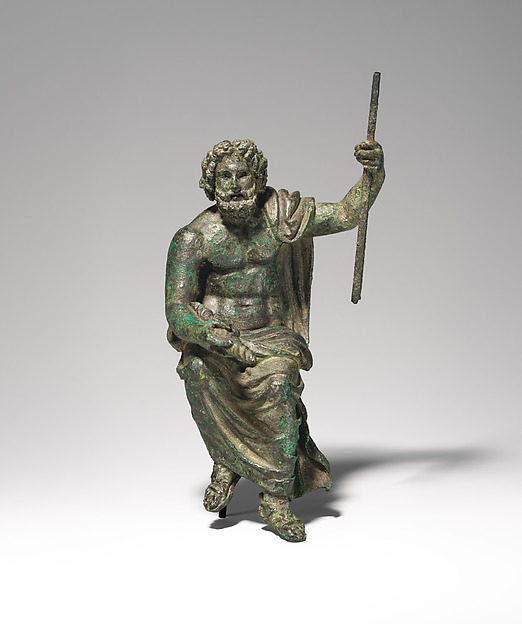
A thunderbolt in a small bronze
The Met identifies this first–second-century CE bronze as Jupiter Capitolinus. The figure is less than twelve centimeters high, yet its seated pose, thunderbolt and scepter communicate imposing authority. Its scale makes it a useful contrast with Rome’s monumental sanctuary.
Religion at the heart of civic life
The Capitoline temple housed Jupiter, Juno and Minerva. It was also a place for public records, senatorial activity and triumphal ceremony. Those overlapping uses show why separating “religion” from “politics” too sharply can obscure Roman experience.
The building was repeatedly damaged and rebuilt. Read the surviving remains alongside ancient accounts rather than treating a modern reconstruction as a photograph of one unchanged temple.
Numa and the dangerous sky
In Fasti 3.285–392, Ovid tells how King Numa responded to Jupiter’s lightning and obtained a divine pledge for Rome. The narrative combines anxiety, wit and ritual knowledge. It presents a story about religious origins, rather than an eyewitness record of the regal period.
Jupiter in an English Bible
The KJV uses Jupiter in Acts 14, where the Greek text names Zeus. That translation choice does not relocate the scene from Lystra to Rome. Compare Zeus and Mercury to follow both sets of names without treating every local cult as identical.
Research Paths
The Met · Bronze statuette of Jupiter Capitolinus ↗
Roman bronze, first–second century CE; museum identification, dimensions and provenance.
Ovid · Fasti, Book 3 ↗
English primary text · find 285–392 for Numa and Jupiter.
Andrew Findley · Temple of Jupiter Optimus Maximus ↗
Open scholarly introduction · architectural remains, rebuilding and civic ceremonies.
Read the related chapters
Keep exploring
Temples, ritual and sacred objects →