
The Roman World of the Bible
Explore Rome’s rise, its connected provinces and the changing local governments surrounding Jewish and early Christian life.
MEMBER RESEARCH EDITIONSee the additional member research ↓
ROME · POWER ACROSS THE MEDITERRANEAN
An empire that reshaped the world
From a city on the Tiber, Rome conquered an empire stretching from Britain to Egypt and across the Mediterranean. Its armies seized territory; roads, ports and provincial governments held it together. Augustus established rule by emperors in 27 BCE, following centuries of republican expansion. Roman power transformed cities, trade and daily life—and demanded taxes, tribute and obedience.
The New Testament unfolds within this empire: Herod’s building projects, a governor’s tribunal, crowded provincial cities and journeys along imperial routes. Rome’s wars devastated Jerusalem and its Temple, while Jewish communities and emerging Christian movements continued to develop across its territories. The empire eventually fractured, but its influence endured in law, languages, architecture and government.
Who held power in New Testament Judea?
An emperor in Rome, a ruler in Galilee and a high priest in Jerusalem exercised different kinds of authority. Their relationships changed with appointments, territorial divisions and war.
- Emperor
- Held supreme imperial authority, supported by armies and officials. Rome could appoint or remove the rulers on whom local government depended.
- Roman governors
- Administered particular territories, overseeing taxation, public order and judicial authority. Pontius Pilate governed Judea as prefect while Herod Antipas ruled Galilee and Perea.
- Client kings and local rulers
- Governed under Roman oversight. Herod the Great was a client king; his successors held different territories and titles, including ethnarch and tetrarch.
- High priest and Jerusalem’s council
- The high priest led the Temple establishment. Jerusalem’s governing council, commonly called the Sanhedrin, exercised religious and judicial authority within limits shaped by the ruling regime; scholars debate the precise extent of its powers.
- Pharisees and Sadducees
- Jewish religious groups with differing approaches to law and tradition. Some Sadducees were associated with priestly elites, while Pharisees were known for interpreting Torah and inherited traditions. These groups influenced religious and public life; they were not separate levels of Roman government.
For example, around 30 CE, Tiberius was emperor, Pilate governed Judea, Antipas ruled Galilee and Perea, and Caiaphas was high priest. A chapter’s location and date help identify which authority mattered.
Timeline: expansion, local rule and imperial change
- Republican government begins
Rome’s remembered transition from kings to republican institutions.
- A republic builds an empire
Conquests and alliances extend control around the Mediterranean.
- Pompey intervenes at Jerusalem
Rome becomes decisive in Judean politics.
- Caesar is assassinated
Civil war continues after the dictator’s death.
- Herod governs a client kingdom
Royal buildings reshape Jerusalem, Caesarea and desert sites.
- Octavian becomes Augustus
Actium, Egypt’s annexation and the settlement of 27 mark the transition.
- Direct Roman government in Judea
Archelaus’s removal changes the administration of his territories.
- Pilate serves as prefect
Galilee remains under Antipas during this period.
- Agrippa I’s kingdom
A brief royal government precedes the return of provincial officials.
- War, destruction and continued resistance
Jerusalem falls in 70; Masada belongs to a later stage.
- Diaspora uprisings
These conflicts are distinct from both the first revolt and Bar Kokhba’s war.
- Bar Kokhba revolt
Hadrianic warfare and reorganization reshape Judea.
- Citizenship expands
Caracalla’s grant extends citizenship to nearly all free inhabitants; the map below shows an earlier imperial extent.
Selected emperors, local rulers and officials
This list includes different offices and overlapping governments, not one continuous succession. Some intervening emperors are omitted. Conventional dates can vary at the margins.
- Augustus27 BCE–14 CE
- Tiberius14–37 CE
- Gaius / Caligula37–41 CE
- Claudius41–54 CE
- Nero54–68 CE
- Galba, Otho and Vitellius68–69 CE; competing short reigns
- Vespasian69–79 CE
- Titus79–81 CE
- Domitian81–96 CE
- Trajan98–117 CE
- Hadrian117–138 CE
- Herod the Great37–4 BCE; appointed king in 40 BCE
- Archelaus4 BCE–6 CE; ethnarch
- Antipas4 BCE–39 CE; tetrarch of Galilee and Perea
- Philip4 BCE–34 CE; tetrarch of northeastern territories
- Agrippa I37–44 CE; Judea added to his kingdom in 41
- Pontius Pilate26–36 CE, conventional prefecture dates
Locate the provinces around the Mediterranean
This map shows the empire near its greatest extent under Trajan, later than Jesus’s ministry and Paul’s journeys. Provincial borders and local governments changed; use the date when comparing a chapter’s setting.
The Roman Empire near its maximum extent
This is later than most New Testament settings and is included to orient the larger provincial system at its maximum reach.
Map: ArdadN · Public domain · source and license ↗Look closely at the surviving records
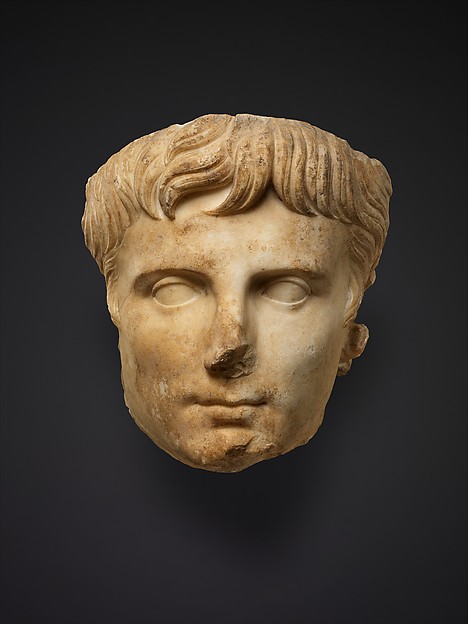
Augustus: the founder remains young
Ca. 14–37 CE · marble · Metropolitan Museum of Art, 07.286.115
Made after Augustus’s death, this portrait preserves an idealized image of Rome’s first emperor. Such images helped sustain imperial authority across reigns and places.
What to notice: The carefully arranged hair and calm expression belong to an official portrait tradition. This is a posthumous likeness, not an image documenting the emperor’s old age.
The Metropolitan Museum of Art. Rogers Fund, 1907. Public domain; Met Open Access (CC0). Image source · Public domain / CC0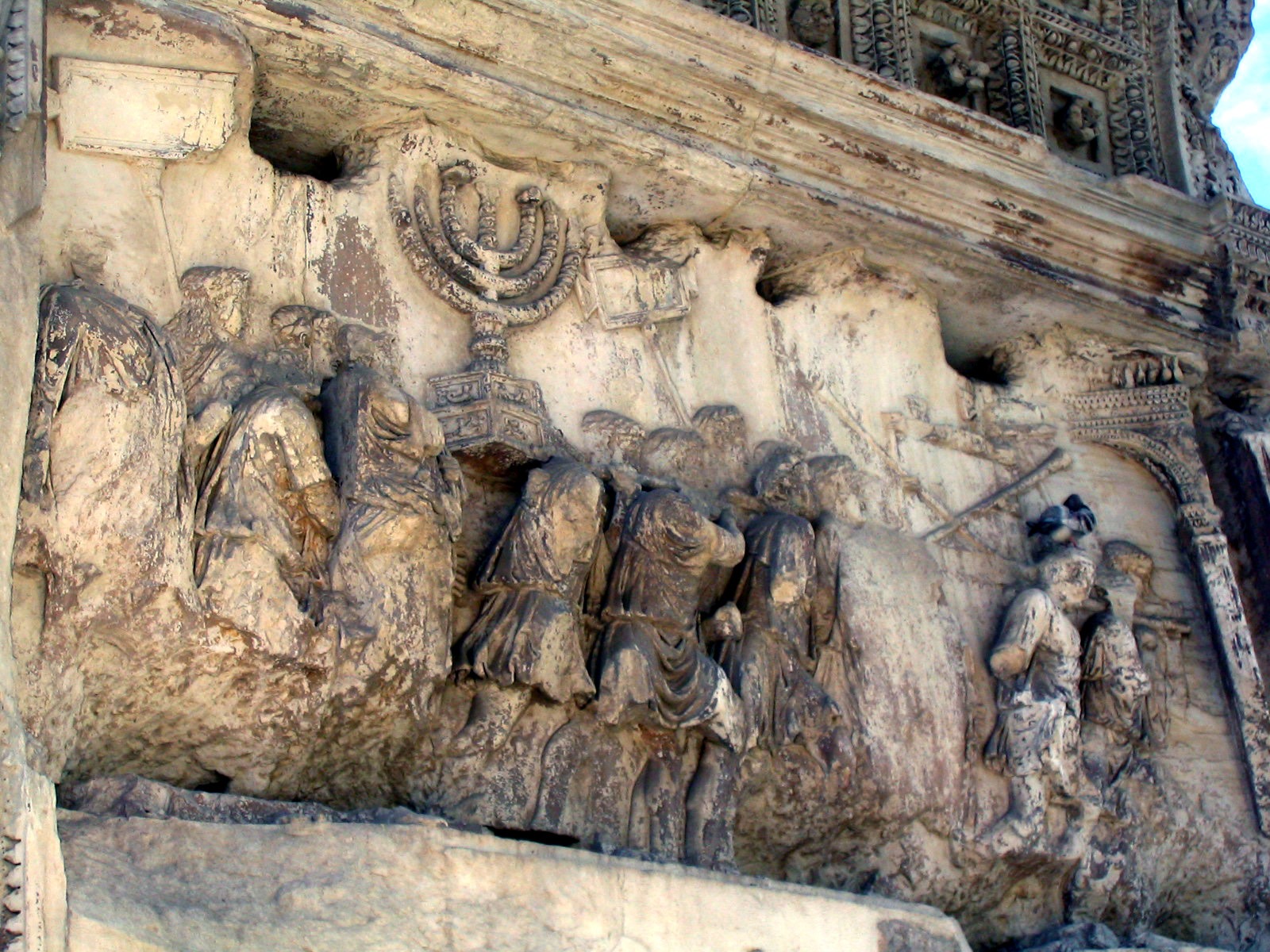
The Arch of Titus: Jerusalem’s spoils in a Roman procession
After 81 CE, under Domitian · marble relief · Arch of Titus, Rome
The relief commemorates the Roman triumph following Jerusalem’s capture in 70 CE. The temple menorah appears among the spoils carried into the capital, connecting events in Judea with imperial memory in Rome.
What to notice: Find the seven-branched menorah above the procession. The monument presents Roman victory; it does not preserve the experiences of all those affected by the war.
- Exodus 25:23–40 →
The sanctuary instructions describe a table and seven-branched lampstand. The relief depicts later Jerusalem Temple furnishings; it does not identify them as the original wilderness objects.