
The Bronze Age World
Orient yourself to the international system behind Egypt, Canaan, the Hittites, Ugarit, and the Amarna correspondence.
MEMBER RESEARCH EDITIONSee the additional member research ↓
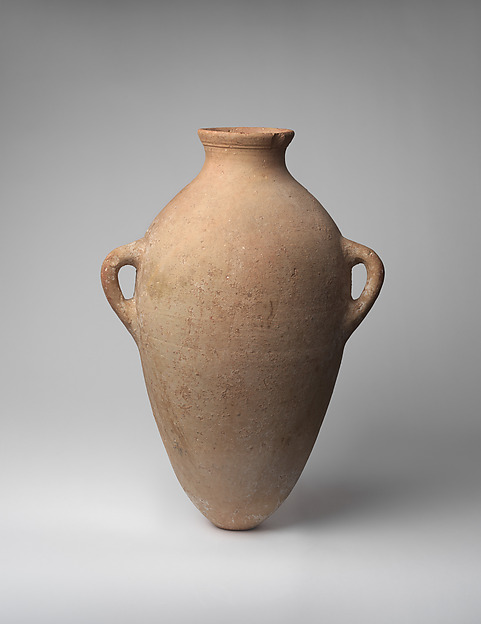
A connected material world
Canaanite jar, ca. 1500–1400 BCE. The Metropolitan Museum of Art, 2001.761.9.
Public domain · The Met Open Access / CC0Open the collection record ↗Follow the changing landscape
Each map shows a particular period or geographic setting. Read its date and caption alongside the timeline.
The Late Bronze Age great-power system
Egypt, Hatti, Assyria, Babylonia, Mitanni, and neighboring regions. Boundaries represent an approximate moment, not the whole Bronze Age.
Map: Enyavar · CC BY-SA 4.0 · source and license ↗Historical periods at a glance
Dates are approximate and may vary between regions and scholarly chronologies.
Timeline
- Thutmose III
Egyptian campaigns reinforce Egypt’s power in Canaan and Syria.
- Amarna correspondence
Royal courts and Canaanite city rulers exchange Akkadian cuneiform letters with Egypt.
- Battle of Kadesh
Egypt and Hatti contest influence in Syria; both courts preserve their own accounts.
- Egyptian–Hittite treaty
Ramesses II and Hattusili III formalize peace and mutual obligations.
- Regional transformations
Ugarit is destroyed and several palace systems end, but the sequence and causes differ by region.
Rulers and scribes
Amenhotep III
A major diplomatic ruler represented extensively in the Amarna correspondence.
Akhenaten
Moved the royal court to Akhetaten, where the Amarna archive was later found.
Šuppiluliuma I
Expanded Hittite control into Syria and altered the balance among the great powers.
Niqmaddu II
Ruled Ugarit during its close involvement with neighboring powers and international trade.
Ramesses II
Fought at Kadesh and later concluded a treaty with the Hittite king Hattusili III.
Hattusili III
Hittite king associated with the Egyptian–Hittite peace treaty.
Explore the surviving material world
Each card opens a museum, excavation project, or heritage record for the named object or site.
An Amarna letter from a Canaanite ruler
- Date
- 14th century BCE
- Where
- British Museum
A real diplomatic tablet from the network linking Canaanite city rulers with the Egyptian court.
View the object or record ↗CITY & COLLECTIONMegiddo in the Late Bronze Age
- Date
- c. 1550–1200 BCE
- Where
- University of Chicago ISAC
Excavated architecture and objects place one Canaanite city within regional routes and political change.
View the object or record ↗CAPITAL & ARCHIVEHattusha, Hittite capital
- Date
- 2nd millennium BCE
- Where
- UNESCO World Heritage Centre
City walls, gates, temples, and tablet archives document the center of the Hittite state.
View the object or record ↗CITY & ARCHIVERas Shamra–Ugarit
- Date
- Late Bronze Age
- Where
- Mission de Ras Shamra–Ougarit
Palaces, houses, temples, and multilingual tablets preserve the life of a major Syrian port city.
View the object or record ↗A connected world of palaces, ports, caravans, and correspondence
“Bronze Age” is an archaeological period label whose local dates vary. In the eastern Mediterranean, the Late Bronze Age—roughly the sixteenth through early twelfth centuries BCE—linked Egypt, Anatolia, Syria, Canaan, Cyprus, Mesopotamia, and the Aegean through diplomacy, warfare, migration, and exchange.
What caused the transformations around 1200 BCE?
Researchers investigate interacting pressures including drought, disrupted trade, conflict, migration, internal political strain, and earthquakes. The balance differs by site and region, so “collapse” should not be treated as one simultaneous event with one cause.