
Israel, Judah, and Jerusalem
Samaria and Jerusalem were capitals of distinct kingdoms. Use the dated maps and timeline to follow their changing settings under Assyrian, Babylonian, Persian, Hellenistic and Roman rule.
MEMBER RESEARCH EDITIONSee the additional member research ↓
Follow the changing landscape
Each map shows a particular period or geographic setting. Read its date and caption alongside the timeline.
Israel, Judah, and neighboring kingdoms
An approximate ninth-century reconstruction. Borders changed repeatedly and should not be applied to every biblical reign.
Map: FinnWikiNo; derivative Richardprins · CC BY-SA 3.0 · source and license ↗Assyria and the fall of Samaria
A second dated view shows why the ninth-century kingdoms map cannot represent the political landscape after Assyrian expansion.
Map: The Bible Directory · Custom geographic orientation mapOne timeline, changing political worlds
The final destruction is dated 587 or 586 BCE in different chronological reconstructions.
- Israel in an Egyptian inscription
Merneptah’s victory stele names Israel in Canaan; this is a people, not a map of the later kingdom.
- Saul, David and Solomon in Samuel and Kings
The biblical account places kingship, Jerusalem and temple building in this sequence. The scale and archaeological chronology of the early monarchy remain debated.
- Two kingdoms in neighboring records
Samaria is the northern capital; inscriptions refer to rulers and dynasties of Israel and Judah.
- Samaria falls and is reorganized
Assyria ends the northern monarchy and restructures its territory.
- Assyria invades Judah
Lachish is captured; Jerusalem is not taken.
- Babylon captures Jerusalem
Nebuchadnezzar replaces its king. See 2 Kings 24.
- Jerusalem and its temple are destroyed
The later campaign is distinct from the capture in 597. See 2 Kings 25.
- Persian-period Yehud
Restoration, temple rebuilding and local administration take place under Persian imperial rule.
- The Second Temple is completed
Ezra 6 places completion in the sixth year of Darius I.
- Macedonian conquest
Alexander’s campaign changes the region’s imperial setting.
- Seleucid control
Antiochus III’s victory brings Judea under Seleucid rule after Ptolemaic control.
- Maccabean revolt and rededication
Revolt begins under Antiochus IV; the Jerusalem temple is rededicated in 164 BCE.
- Hasmonean rule
Local leadership develops into an expanding dynasty of high priests and rulers.
- Pompey takes Jerusalem
Roman intervention reshapes Hasmonean rule.
- Herod the Great
A Roman-backed king rules Judea and undertakes major building projects.
- Roman provincial administration
Judea comes under direct Roman administration, with later changes including Agrippa I’s reign.
- Jerusalem and the Second Temple are destroyed
Roman forces commanded by Titus capture the city during the First Jewish–Roman War.
- Bar Kokhba revolt
A later revolt against Rome transforms Judea again. Some chronologies extend final operations into 136 CE.
Timeline sources
Yale — ancient Judaism chronology ↗ · Met — Seleucid rule ↗ · Israel Museum — Bar Kokhba-period record ↗
Kings, rulers and scribes
Before these sequences, the biblical narrative describes Saul, David and Solomon (1 Samuel 9–1 Kings 11). The two lists below follow each kingdom’s succession independently. Dates provide orientation, using one conventional published reconstruction; alternative scholarly chronologies differ. A slash marks alternative calendar years, and overlapping dates can reflect proposed co-rule or rival claims.
Israel — northern kingdom
- Jeroboam IApproximate reign: 931/930–911/910 BCE1 Kings 12–14
- NadabApproximate reign: 911/910–910/909 BCE1 Kings 15
- BaashaApproximate reign: 910/909–887/886 BCE1 Kings 15–16
- ElahApproximate reign: 887/886–886/885 BCE1 Kings 16
- ZimriApproximate reign: 886/885 (seven days) BCE1 Kings 16
- Tibni — rival claimantApproximate reign: c. 886/885–881/880 (rival claim) BCE1 Kings 16
- OmriApproximate reign: 886/885–875/874 BCE1 Kings 16
- AhabApproximate reign: 875/874–853 BCE1 Kings 16–22
- AhaziahApproximate reign: 853–852 BCE1 Kings 22; 2 Kings 1
- Jehoram / JoramApproximate reign: 852–841 BCE2 Kings 3
- JehuApproximate reign: 841–814/813 BCE2 Kings 9–10
- JehoahazApproximate reign: 814/813–798/797 BCE2 Kings 13
- Jehoash / JoashApproximate reign: 798/797–782/781 BCE2 Kings 13–14
- Jeroboam IIApproximate reign: 782/781–753 (possible co-rule from 793/792) BCE2 Kings 14
- ZechariahApproximate reign: 753–752 (six months) BCE2 Kings 15
- ShallumApproximate reign: 752 (one month) BCE2 Kings 15
- MenahemApproximate reign: 752–742/741 BCE2 Kings 15
- PekahiahApproximate reign: 742/741–740/739 BCE2 Kings 15
- PekahApproximate reign: 740/739–732/731 (rival claim possibly from 752) BCE2 Kings 15
- HosheaApproximate reign: 732/731–722 BCE2 Kings 17
Judah — southern kingdom
- RehoboamApproximate reign: 931/930–915/914 BCE1 Kings 12–14
- Abijah / AbijamApproximate reign: 915/914–912/911 BCE1 Kings 15; 2 Chronicles 13
- AsaApproximate reign: 912/911–871/870 BCE1 Kings 15
- JehoshaphatApproximate reign: 871/870–849/848 (possible co-rule from 873) BCE1 Kings 22
- Jehoram / JoramApproximate reign: 849/848–842 (possible co-rule from 853) BCE2 Kings 8
- AhaziahApproximate reign: 842–841 BCE2 Kings 8–9
- Athaliah — queenApproximate reign: 841–835 BCE2 Kings 11
- Joash / JehoashApproximate reign: 835–796/795 BCE2 Kings 11–12
- AmaziahApproximate reign: 796/795–767 BCE2 Kings 14
- Uzziah / AzariahApproximate reign: 767–740/739 (possible co-rule from 791) BCE2 Kings 15; 2 Chronicles 26
- JothamApproximate reign: 750–735/730 (overlaps Uzziah) BCE2 Kings 15
- AhazApproximate reign: 735/730–715 BCE2 Kings 16
- HezekiahApproximate reign: 715–687/686 (possible co-rule from 728) BCE2 Kings 18–20
- ManassehApproximate reign: 687/686–642 (possible co-rule from 697/696) BCE2 Kings 21
- AmonApproximate reign: 642–640 BCE2 Kings 21
- JosiahApproximate reign: 640–609 BCE2 Kings 22–23
- Jehoahaz / ShallumApproximate reign: 609 (three months) BCE2 Kings 23; Jeremiah 22
- Jehoiakim / EliakimApproximate reign: 609–598 BCE2 Kings 23–24
- Jehoiachin / JeconiahApproximate reign: 598–597 (three months) BCE2 Kings 24; Jeremiah 24
- Zedekiah / MattaniahApproximate reign: 597–586 (destruction also dated 587) BCE2 Kings 24–25
After the monarchy: selected rulers and local figures
- Persian period · 539–332 BCECyrus II and Darius I — Persian kings; Zerubbabel and Nehemiah — governors; Ezra — scribe in the biblical accounts.
- Hellenistic rule · from 332 BCEAlexander III; the Ptolemaic and Seleucid dynasties, including Antiochus III and Antiochus IV.
- Hasmonean leadership · second–first centuries BCESimon and John Hyrcanus I — high priests and political leaders; Alexander Jannaeus — king and high priest; Salome Alexandra — queen.
- Roman intervention · from 63 BCEPompey — Roman general; Hyrcanus II — high priest within the changing political settlement.
- Herodian rule · late first century BCE–first century CEHerod the Great — Roman-backed king. After him, Archelaus governed Judea as ethnarch; Antipas governed Galilee and Perea as tetrarch.
- Roman administration · first century CEPontius Pilate — prefect of Judea. Direct administration and client rule changed over time; Agrippa I later ruled as king.
- War and its aftermath · 70–135 CETitus — Roman commander at Jerusalem in 70 CE; Hadrian — emperor during the Bar Kokhba revolt; Simon bar Kosiba (Bar Kokhba) — revolt leader.
Dating references: Published Israel chronology ↗ · Published Judah chronology ↗ · McKenzie: chronology and its limits, pp. 45–46 ↗
The kingdom successions follow Kings, with selected parallel passages. Later figures are a selective orientation, with their different offices identified. Later date labels identify the period of activity, not an individual reign. Ezra’s chronology and the proposed overlaps in the monarchy remain debated.
Israel and Judah: two kingdoms, different histories
Israel and Judah were neighboring kingdoms with distinct capitals: Samaria in the north and Jerusalem in the south. Their rulers, sanctuaries and communities developed amid trade, regional rivalry and the ambitions of larger empires. An Egyptian inscription names Israel around 1208/1207 BCE; later inscriptions and archaeological remains illuminate the kingdoms and their changing political strength.
Assyria ended Israel’s monarchy; Babylon destroyed Jerusalem and its temple. Persian restoration, Hellenistic rule and Herod’s monumental building brought further transformations before Rome’s destruction of the Second Temple in 70 CE. Across these changes, Jerusalem became central to traditions of scripture, worship and communal memory that continue to shape Jewish, Christian and, in later centuries, Muslim traditions. The scale of David and Solomon’s earlier kingdom remains debated; the Tel Dan reference to the “House of David” identifies a dynasty rather than its territory.
Assyria reshapes the region
Assyrian conquest ended Israel’s monarchy in the late eighth century BCE. Judah survived, but faced imperial demands and devastating campaigns. In 701 BCE, Sennacherib captured Lachish and other Judean cities; Jerusalem remained under Hezekiah. The member discussion of Sennacherib’s inscription illuminates these different outcomes. Explore the siege reliefs on the Assyria page.
Babylon conquers Jerusalem
Babylon captured Jerusalem in 597 BCE, replacing its king and deporting people. The later destruction of the city and temple, commonly dated 587 or 586 BCE, was a separate catastrophe. These successive disruptions provide essential context for exile passages.
Life under Persian rule
After Persia conquered Babylon in 539 BCE, Judah belonged to a new imperial setting. Return and rebuilding did not restore an independent kingdom. Jerusalem’s temple was rebuilt, while Jewish communities also continued beyond Judah.
Jerusalem under Greek and Roman rule
Alexander’s conquests brought another change, followed by Ptolemaic, Seleucid and Hasmonean rule. Under Roman-backed Herod, the rebuilt Second Temple and its platform were greatly expanded. The stonework below belongs to this later precinct. Roman forces destroyed the temple in 70 CE; the timeline continues through the Bar Kokhba revolt.
Look closely at the surviving records

Israel before the kingdoms: the Merneptah stele
c. 1208/1207 BCE · Egyptian royal victory inscription · photographed in Cairo in 2016
Near the end of its victory account, this Egyptian inscription names Israel in Canaan. It is the earliest widely accepted reference to Israel outside the Bible. The reference concerns a people, not the borders of the later northern kingdom, and does not explain their origins.
What to notice: Most of this tall monument concerns Egyptian royal victories. The short reference to Israel occurs in the concluding lines about Canaan; the monument is not an account of the Exodus.
Photograph: Alyssa Bivins, 2016. CC BY-SA 4.0. Proportionally resized; no crop. Image source · CC BY-SA 4.0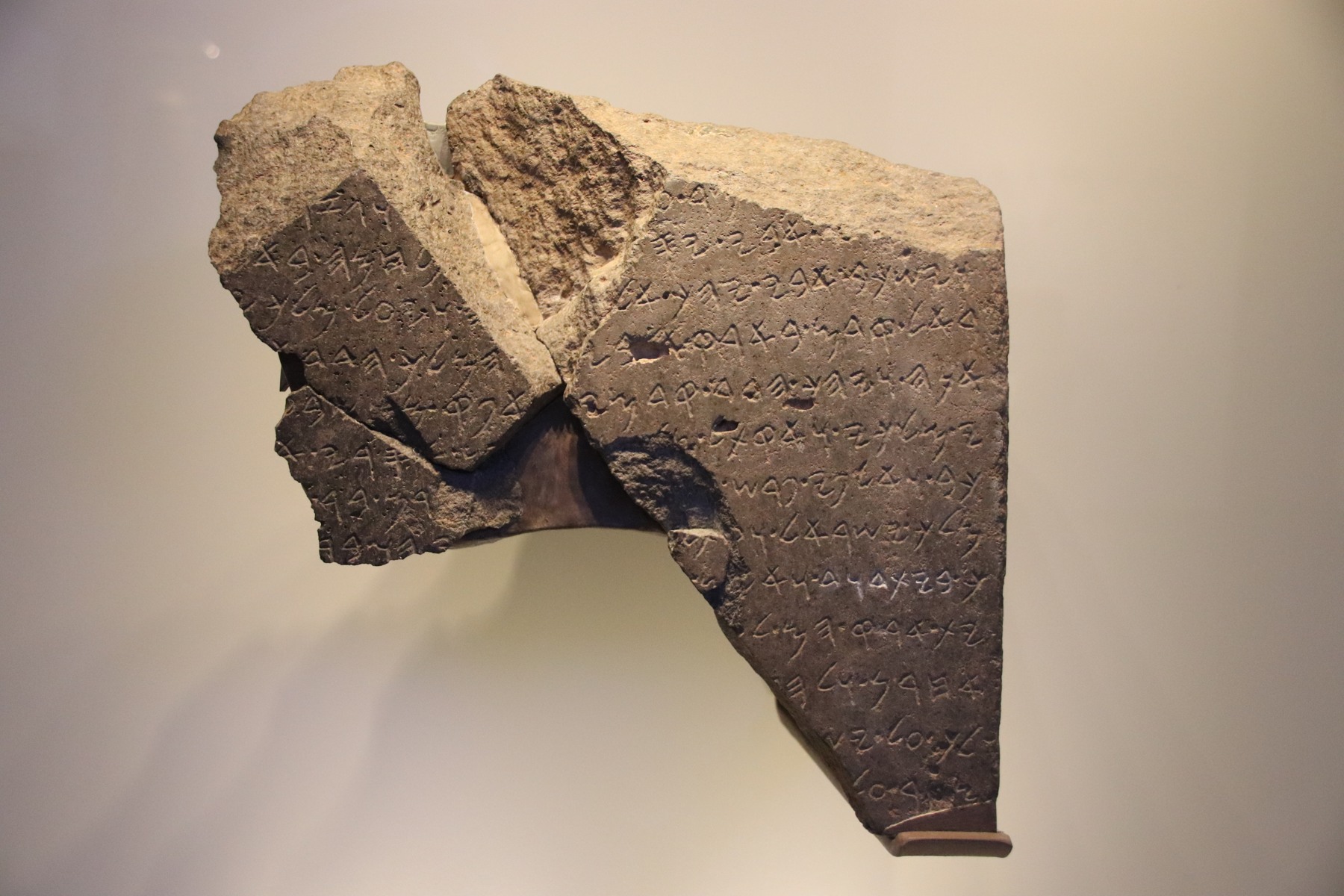
The Tel Dan stele: a neighboring king names the House of David
Ninth century BCE · from Tel Dan · Israel Museum, Jerusalem
This Aramaic victory inscription is widely read as referring to the House of David, the dynasty associated with Judah. It supplies a neighboring kingdom’s account of royal conflict. The monument is later than David’s lifetime and does not establish the size or wealth of his kingdom.
What to notice: The surviving pieces have broken edges and gaps. A scholarly transcription distinguishes letters that survive from words restored by editors.
Photograph: Gary Todd, 2018. CC0 1.0. Proportionally resized; no crop. Image source · CC0 1.0
Herod’s building program: the distinctive stonework
Herodian / Early Roman temple precinct · Western Wall, Jerusalem · modern photograph
Herod the Great’s expansion of Jerusalem’s temple precinct used massive limestone blocks with carefully recessed borders, called drafted margins. These surviving stones show the masonry associated with his monumental building program. They formed the precinct’s retaining wall; construction continued after his death.
What to notice: Trace the narrow border around the raised central face. The stone’s outline becomes visible within the larger wall. This photograph shows masonry; dating a particular course also requires its archaeological setting.
Photograph: Gilabrand at English Wikipedia. CC BY 3.0. Original file reproduced without alteration. Image source · CC BY 3.0