
Early Mesopotamia
Discover cities, royal monuments and written traditions that shaped the ancient Near East.
MEMBER RESEARCH EDITIONSee the additional member research ↓
Cities rose. Empires followed.
Between the Tigris and Euphrates, Mesopotamian communities built some of the world’s earliest cities and developed writing that transformed how people governed, traded and preserved knowledge. Uruk became a vast urban center; Sumerian cities raised monumental temples; Akkadian kings extended their rule across competing kingdoms. Their influence reached far beyond the river plains through conquest, diplomacy and trade.
The kingdoms changed, but their written traditions endured. Ur’s administrative records, Mari’s royal letters and Hammurabi’s legal collection reveal how rulers governed and people managed their lives. Scribes also preserved stories about creation, floods, friendship and mortality—traditions that invite careful comparison with biblical literature. Long before Assyria’s expansion or Nebuchadnezzar’s Babylon, Mesopotamia had created a world of cities, institutions and scholarship that later generations inherited and reshaped.
From early cities to Old Babylonian kingdoms
Dates are approximate. The later entries use the conventional Middle Chronology; alternative chronologies shift some reigns and events.
- Uruk and early writing
Large settlements, monumental institutions and accounting tablets develop.
- Early Dynastic city-states
Rival centers include Ur, Uruk and Lagash; elite graves reveal extensive craft and trade networks.
- Akkadian dynasty
Sargon and his successors extend control beyond individual cities.
- Gudea and local kingship
Temple building and inscribed statues preserve a distinct royal world.
- Third Dynasty of Ur
Royal government produces extensive administrative records.
- Isin-Larsa and Old Babylonian worlds
Changing kingdoms include Mari and Babylon; Hammurabi’s conventional reign is 1792–1750 BCE.
- A continuing scribal legacy
Later kingdoms preserve and develop older languages, texts and institutions.
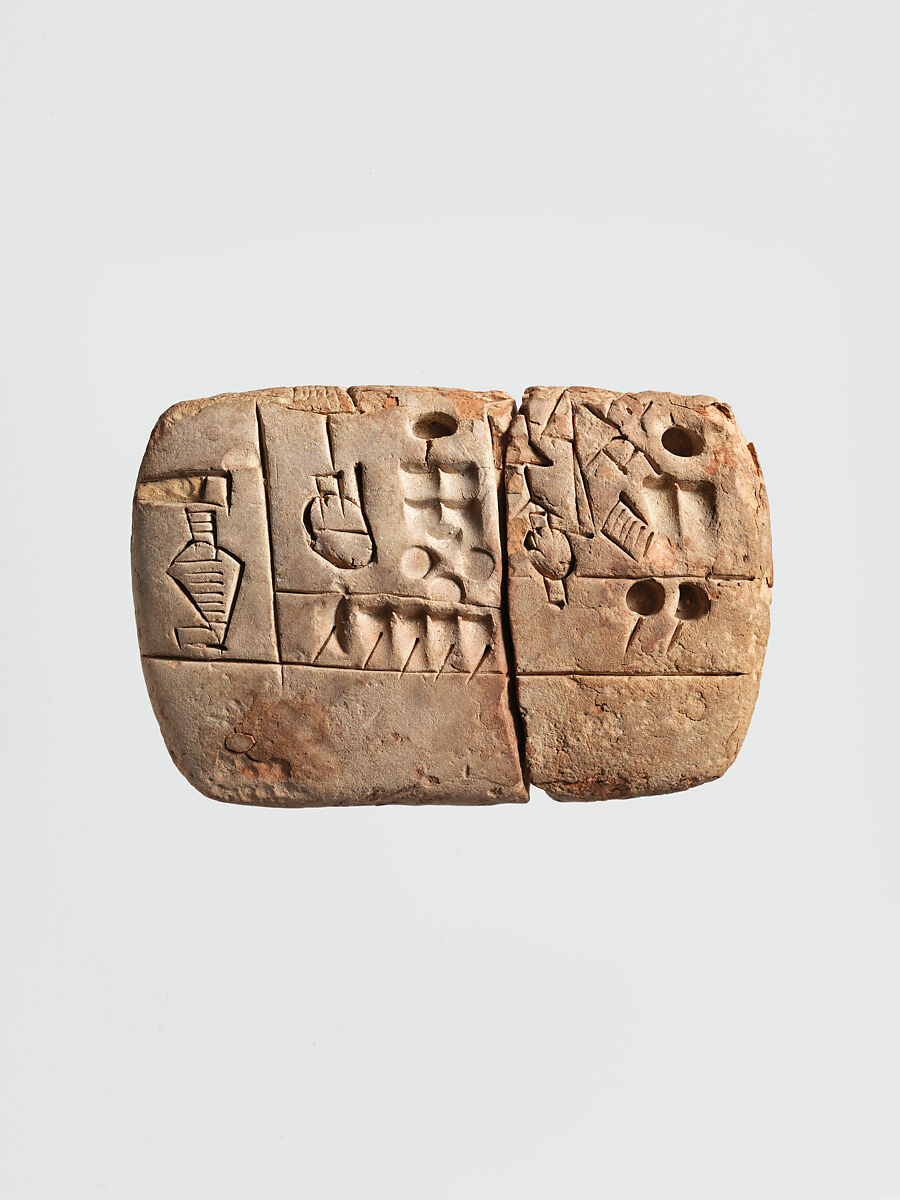
A grain account captures writing’s early purpose
This small clay tablet records quantities of malt and barley groats around 3100–2900 BCE. It shows how early writing helped institutions keep track of goods: information could be recorded, checked and preserved beyond a person’s memory. These practical records were part of the development of writing into a tool for laws, letters and literature.
Probably from Uruk · Metropolitan Museum of Art, 1988.433.3.
The Metropolitan Museum of Art. Purchase, Raymond and Beverly Sackler Gift, 1988. Public domain; Open Access CC0. Object record ↗ · Image license ↗Cuneiform carried languages across centuries
Sumerian was spoken in southern Mesopotamia and appears in some of the region’s earliest written records. It has no demonstrated relationship to another known language. Akkadian, used alongside it and increasingly dominant in later periods, belonged to the Semitic language family, which also includes Hebrew and Aramaic. Babylonian and Assyrian were varieties of Akkadian.
Scribes wrote both Sumerian and Akkadian in cuneiform, a system of signs impressed into clay with a stylus. Think of the distinction between a language and an alphabet: English and Spanish share an alphabet, but remain different languages. Cuneiform likewise served several languages, although its signs worked differently from alphabetic letters. Sumerian continued in scholarship and religious texts long after it ceased to be an everyday spoken language.
Explore languages and writing →
Sources for this overview
Uruk and urban life ↗ · Origins of writing ↗ · Old Babylonian history, revised 2025 ↗
Follow the changing landscape
Each map shows a particular period or geographic setting. Read its date and caption alongside the timeline.
Mesopotamia and the western corridor
A broad geographic orientation from southern Mesopotamia toward the upper Euphrates and Levant; it does not assign a historical route to a named individual.
Map: The Bible Directory · Custom geographic orientation map