
The Neo-Assyrian Empire
When Kings and the prophets name Assyria, they bring a northern Mesopotamian empire into the story. Follow its reach toward Samaria and Jerusalem, then examine how its rulers displayed power—and collected knowledge.
Assyria: an empire of armies, cities and libraries
From its northern Mesopotamian heartland, Assyria built an empire reaching across the Levant and, for a time, into Egypt. Armies captured cities; governors, tribute and forced population movements sustained imperial rule. Palace reliefs made conquest visible, while royal archives and Ashurbanipal’s collections at Nineveh preserved records, literature and learned traditions.
Assyrian expansion ended Israel’s monarchy and brought Judah under intense pressure. Nineveh fell in 612 BCE, followed by the collapse of imperial resistance. The tablets survived to reopen this world to modern scholarship, including major copies of the Epic of Gilgamesh. Assyrian communities and identities continued beyond the empire’s fall.
Timeline: expansion, succession and collapse
- A palace court at Kalhu
Ashurnasirpal II develops Kalhu (Nimrud) as a royal center in Assyria’s northern Mesopotamian heartland.
- Israel enters the Assyrian royal record
Shalmaneser III’s account of Qarqar names Ahab in a western coalition. Assyrian campaigns connect the northern Mesopotamian court with the Levant.
- Tribute associated with Jehu
The Black Obelisk’s caption identifies the delegation.
- Western kingdoms become provinces
Tiglath-Pileser III expands direct Assyrian government. Governors, tribute and forced population movements reshape the conquered territories.
- Samaria’s conquest and reorganization
Shalmaneser V and Sargon II belong to successive stages.
- Sargon II moves to a new capital
The court moves to Dur-Sharrukin (Khorsabad). His successor Sennacherib develops Nineveh as the royal capital.
- Lachish falls; Jerusalem survives
Sennacherib’s campaign devastates Judah. The reliefs celebrate Lachish’s capture; his inscription describes Hezekiah confined in Jerusalem.
- An oath for the next king
Esarhaddon arranges loyalty to his designated heirs. Surviving tablets let readers examine how succession became a binding obligation.
- Older stories are copied at Nineveh
Ashurbanipal’s collections preserve literature and scholarly texts. The Flood Tablet below is a surviving copy of part of the Epic of Gilgamesh.
- Imperial collapse
Nineveh falls in 612; resistance continues around Harran.
Selected kings and reign dates
Dates below follow the regnal-year convention used by the ORACC inscription projects; other references may begin with the accession year, often one year earlier. This is a selected list, with intervening reigns omitted.
- Ashurnasirpal II883–859 BCE
- Shalmaneser III858–824 BCE
- Tiglath-Pileser III744–727 BCE
- Shalmaneser V726–722 BCE
- Sargon II721–705 BCE
- Sennacherib704–681 BCE
- Esarhaddon680–669 BCE
- Ashurbanipal668–631 BCE
Follow the empire’s changing reach
Compare Assyria’s reach in 824 and 671 BCE, then locate the cities named in the timeline.
Assyria’s expansion in two dated views
Dark green marks the map’s reconstruction for 824 BCE; light green shows its wider reach in 671 BCE. Locate the royal capitals, Samaria and Jerusalem. These are approximate historical boundaries, not modern borders.
Map: Ningyou; resized and converted to WebP · CC BY-SA 3.0 · source and license ↗Look closely at the surviving records
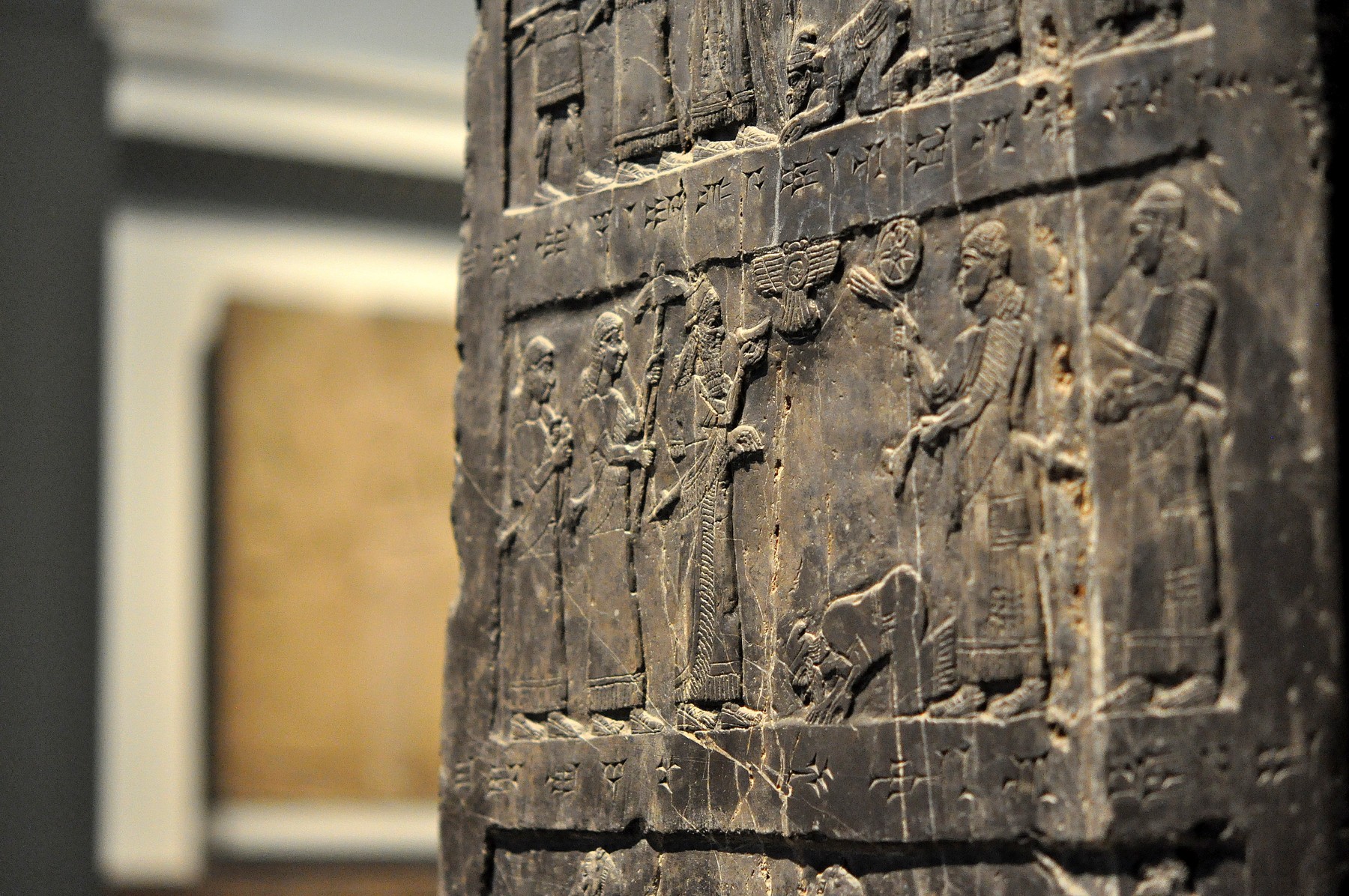
Who is kneeling on the Black Obelisk?
Ninth century BCE · from Nimrud · British Museum
The kneeling figure is conventionally identified as Jehu, king of Israel, submitting to Shalmaneser III. The caption names tribute from Jehu, associated with the House of Omri, in 841 BCE. This makes the scene an exceptionally important connection between an Israelite ruler known from Kings and a contemporary Assyrian monument. The image is a royal presentation of submission, not a portrait whose likeness independently identifies the person.
What to notice: The caption supplies the name; the bowed body and upright Assyrian king communicate unequal power. “House of Omri” was an Assyrian designation for Israel, even though the biblical account describes Jehu overthrowing Omri’s dynasty.
Photo: Osama Shukir Muhammed Amin FRCP(Glasg), 2014. Proportionally resized; no crop. Image source · CC BY-SA 4.0
Why was Gilgamesh in an Assyrian library?
Seventh century BCE copy · Nineveh · British Museum K.3375
Gilgamesh was a legendary king of Uruk in southern Mesopotamia. The epic follows his adventures with Enkidu and, after his companion’s death, his search for escape from mortality. It is a major surviving work of ancient literature, concerned with friendship, kingship and the limits of human life. Older Sumerian stories and later Akkadian versions preceded this seventh-century BCE copy. Ashurbanipal’s scholars at Nineveh collected this inherited literature alongside writings used in royal scholarship.
What to notice: This is part of Tablet XI: the flood survivor Utnapishtim tells Gilgamesh his story. Its parallels with Genesis make it important for comparative biblical study. The tablet’s date is the date of this copy, not the origin of the story; similarities alone do not establish direct borrowing.
Photo: Fæ, 2010. Original photograph, no additional alterations. Image source · CC BY-SA 3.0